Showing posts with label Weight. Show all posts

Monday, May 2, 2016

The Biggest Loser is STUPID

image: realitytea.com


I used to watch the reality show Biggest Loser from time to time. I liked watching the challenges, and I'll admit I got a little choked up at all the transformations, heart-wrenching stories, etc. I was cheesier when I was younger.

In fact, BL was on the TV in the birthing room when I had my first child. I suppose I enjoyed seeing other people grunting and not looking cute and fluffy, because Lord knows, I was not so cute and fluffy at the time.

Anyway, there were always things that bothered me about that show, and the more I learned about diet and exercise, the more I grew to despise it, and now I officially can't stand it. I can't even watch it for five minutes. If you like, me no judgey, but I'm going to tell why:

I hate how they make exercise look like torture. You do not need to vomit to have a good workout. You do not need to walk on treadmills for hours on end. There is almost no joy in movement communicated to the participants on that show. They seem to do the same old same old all.the.time. Why not water aerobics? Ballroom dancing? Or even... barre?! (You knew I was going to say that.) Really, there are so many different ways to move your body. I don't understand why they persist with rope slinging, kettlebell swinging and treadmilling over and over and over. Not to mention the fact that many of these activities are really tough on the joints, and when you're dealing with the morbidly obese, joint issues should be a huge consideration. Not to mention all the emphasis on processed diet food and calorie counting. It makes me crazy.

But today I read an article in the New York Times that made me hate this show even more. It's called 'After The Biggest Loser, Their Bodies Fought to Regain Weight.' The article is heartbreaking. It chronicles the punishing regimes to lose weight fast, and the regain experiences of contestants on the horrible show's season 8, nearly all of whom regained almost all the weight they rapidly lost this stupid show.

And it's not just the season 8 contestants. If you search 'where are they now' type articles, you'll find many, many, many BL contestants have regained all or most of the weight they lost. It's just that the season 8 contestants were studied by the National Institutes of Health. They found that all the contestants had significantly slower metabolisms after participating on the show. This means they now burn far fewer calories at rest than they did before. This means they MUST eat FAR fewer calories than would be expected for people their size.

Also, since they lost so much weight so rapidly on The Stupid Show, their hormones are messed up. The contestants were found to have almost no leptin, which is one of the hormones that governs the hunger response. After regaining some weight, their leptin levels increased, but not to the previous levels they had enjoyed before The Stupid Show. This means these poor people were HUNGRY ALL THE TIME. Of course they gained the weight back! Who can resist the siren song of HUNGER?

Ok, I really need to go do some laundry, but could we please just get over the number on the scale? Please? It is SO NOT THE MOST IMPORTANT THING. SO NOT. These people would have been so much better off if the emphasis had been on small, sustainable changes, like moderate, enjoyable movement. Like eating WHOLE REAL FOOD. Like focusing on other health markers, such as blood pressure, blood sugar, heck, just ENJOYING LIFE MORE.

Even this article reveals that people are still hung up on weight, even though the maniacal focus is what seems to have permanently damaged their bodies.

The only winners of The Stupid Show are Bob Harper and Jillian Michaels, who have become household names and made money hand over fist from yelling and screaming at people. It certainly wasn't the contestants, nor the millions of people who have watched this show and tried to emulate the results. Enough.

Can we please finally get this stupid show off the air?

Wednesday, May 27, 2015

By Aiming at Weight, We Miss the Mark

I've never liked math, and I've never really been particularly good at it. Math was painful in school, so I had to be creative to get through it. I ended up assigning personalities to the different digits and putting them on teams--the answer to the equation meant a point for the particular team and whichever team had the most points at the end of the worksheet won. I had to make a game of it because it was so painfully boring.

But people love numbers, especially those relating to health. Numbers are neat and tidy, (or so it seems.) Doctors and journalists like to assess people's state of health according to the numbers--weight, body mass index (BMI), cholesterol, blood pressure, etc. Some of those numbers really are significant, like blood pressure. A BP too high or too low really does spell trouble, but those other numbers? Mmmm, maybe not so much.
Image: bradgouthrofitness.com

Recently I read the book Secrets of the Eating Lab by psychologist Traci Mann of the University of Minnesota. Mann spends a good bit of time explaining why diets, that is, restrictive ways of eating that are meant to result in weight loss, are not effective.

Certainly, most people lose weight on diets, but apparently only 5% of dieters are able to maintain this weight loss over the long haul. 

Yes, 95% of people who lose weight through dieting gain back some, all or even more weight. And so they go back to dieting and repeat the process again. And again, and again. This lather, rinse, repeat action is called 'weight cycling,' or in common parlance, 'yo-yo dieting.' Some research suggests this is very not good for us, that remaining heavier is actually healthier than going up and down, over and over. Even if weight cycling were perfectly healthy physically, it has to be massively head-wrecking.

But what about that 5%, you might say?

A few months ago, I watched an HBO documentary called The Weight of the Nation. (It's on youtube, if you're interested, but I can't say I would necessarily recommend it.) One segment features two women who have both lost 100 or so pounds and kept it off for over a year. They're happier and healthier and feel great, and that's great!

But wow... maintaining their lower weights is like a full-time job. They speed-walk miles everyday. They were shown ordering lunch for takeout. Just deciding what they were going to eat involved calculator, pen and paper. It was like a meeting of the Congressional Budget Office. (Not that I've ever been to one, but you know what I mean.) "We could get this instead of that, ask them to cook it this way, take away the sauce and that saves us 200 calories!" For real. This is how these women live. And I respect them for it, but I suspect this kind of effort is why so many people gain back the weight. That's a lot of thinking and math involved in just ordering lunch... even for someone who likes math.

Of course, there are physiological reasons why weight regain happens, but I suspect a lot of it is that the behaviors required to lose the weight in the first place are just not sustainable. Draconian calorie restriction, tedious calorie counting, lengthy and/or unfun, grueling workouts. We just can't keep them up, and so we don't.

Mann recommends shooting for your 'leanest, livable weight,' meaning that number at which you can comfortably live without heroic effort. Research shows we all have a set weight range--a spectrum at which our bodies are most comfortable. We can influence this number to some degree through lifestyle choices, but it requires serious effort to lose--or even gain--a significant amount outside this range.

This sounds like good advice, but I'd really prefer to think of it as adopting habits. Excessive weight gain is sometimes just a symptom of bad habits. Focusing on the weight misses the mark. Shoot for healthy behaviors, tackle them one at a time, until they become (at least somewhat) effortless.

It might require a drastic change at first to break a habit--as I did in giving up sugar last year, but now not eating sugar is normal for me. It's effortless. I don't experience strong cravings or even enjoy very sweet stuff anymore. It didn't result in any significant weight loss--in fact, I've actually gained a little weight in the past year--but reducing my sugar consumption was an absolutely healthy habit. But focusing on the scale number wouldn't have helped me. Instead, I might have become discouraged and been tempted to give up an undoubtedly good habit.

I can appreciate why people like the numbers. They're quantifiable. You can pretty easily measure numbers, but the big picture--the important one--is more than just the math.

Thursday, April 30, 2015

People... People Who Need People: The Story of Weight Watchers

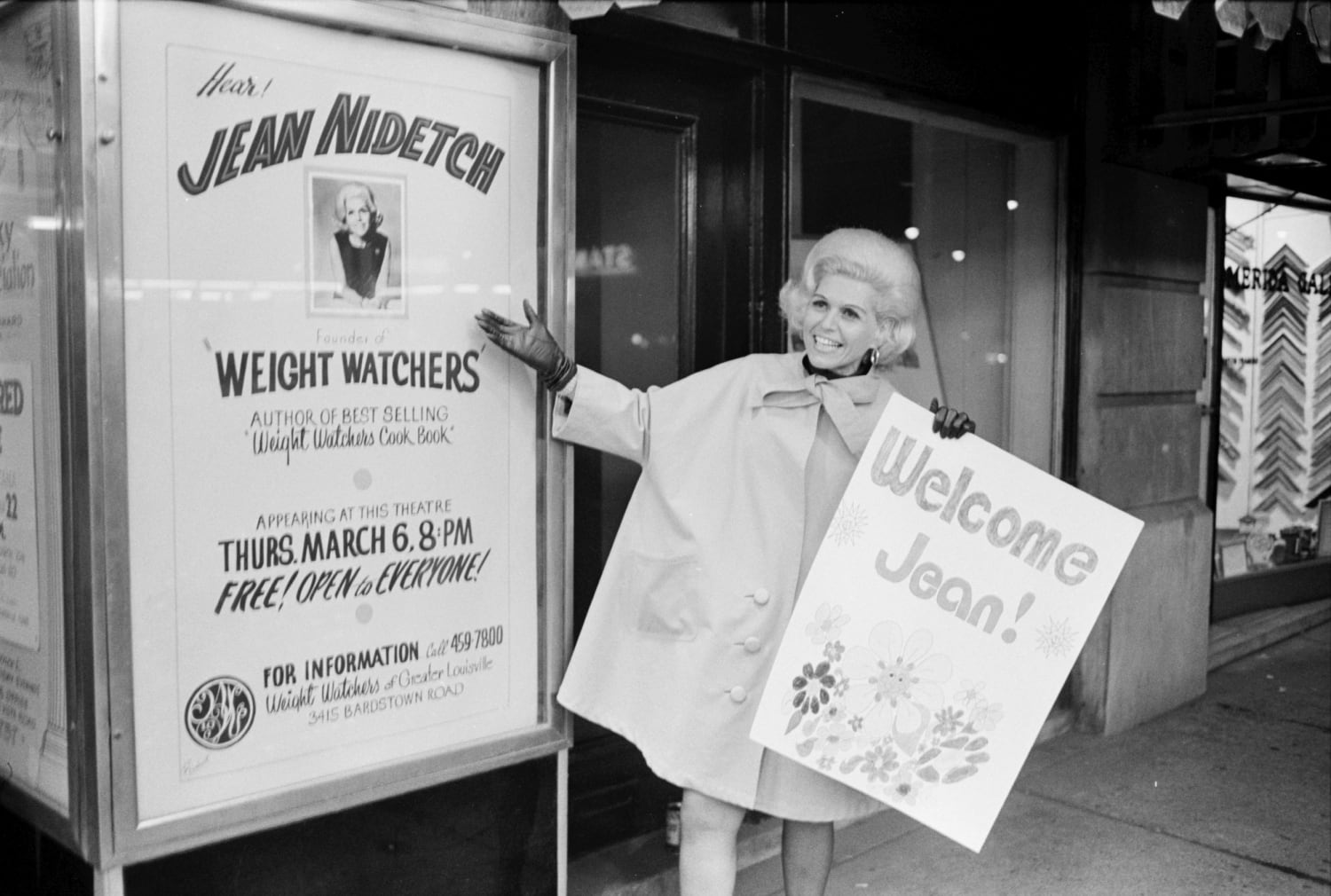
I just read in the newspaper that Jean Nidetch has died at the ripe old age of 91. Don't know who Jean is? Read on, and I'll tell you a story...

Who was Jean?
Jean Nidetch was an unhappy Long Island housewife who was tired of being fat. She had struggled with her weight all her life and was ready to make a change. She consulted her doctor on how to lose weight. He gave her a particular diet and told her to follow it to the letter. Apparently it involved eating liver, which Jean said she didn't like. He told her to 'eat it anyway.'

Jean followed the fairly draconian diet and lost twenty pounds, but found her motivation flagging. So she invited her friends and neighbors into her living room every Saturday morning for weekly weigh-ins, "empathy, rapport and mutual understanding." The group soon outgrew Jean's living room and mushroomed beyond her wildest dreams.
Image: nbcnews.com

Jean and her little group became what we know as Weight Watchers, a weight-loss business that is a household name around the world. (By the way, her maiden name was Slutsky. Can you imagine? I would have gotten married in a New York minute to have gotten rid of that one.)

What's interesting about old school Weight Watchers is that it wasn't about the diet--it was the support of meeting together with others. Weight Watchers' actual eating recommendations have shifted and morphed over the years. The secret of Weight Watchers' initial success is the accountability their system provided. There are WW locations all over the world, and people still go to weekly meetings despite the fact that I'm told they are about as dull as dry toast. Toast that will cost you points, by the way.

How It Works Now
Weight Watchers has changed a lot over the years. It's no longer just about meeting together. It now sells a wide variety of frozen and packaged frankenfood. There is also an online version that people can do on their own.

The modern incarnation of WW is basic calorie counting. They don't specifically count calories--they count 'points,' and each point corresponds to a certain number of calories. I think it's something like 50 calories per point. You are given an allotment of points each day, and once you've exceeded your points, you can't eat anything other than points-free foods, like vegetables. You can eat anything you want, but you have to stay within your points. You figure out pretty quickly not to spend your points frivolously so you don't have to munch on celery for dinner.

Many people have successfully lost weight on this plan, but like most other diets, many of them also gain it back. In fact, even after her great success, with both weight loss and a business that made her a millionaire, Jean continued to struggle with weight for the rest of her life. According to her Wall Street Journal obituary, "Her philosophy on weight loss was that it required constant maintenance. Weight Watchers members were taught to weigh in once a week and stay within two pounds of their goals."

Honestly, I have mixed feelings about Weight Watchers.
I did the online version after I had the Darling Son #2. Life was crazy at that time and I'm an uptight, type-A personality. I needed some accountability to get back on track after the blissful flow of meals from the church ladies stopped. I came within a few pounds of my pre-kids weight and couldn't get any lower. I got frustrated and then just figured that's where my body wanted to be and made my peace with it.

I'm going to talk more about 'goal weight' in another post, but I was initially pretty positive about Weight Watchers. I liked that it didn't put a lot of restriction on what you could eat, instead they just gave you a guideline and had you figure it out. It did give you a sense of ownership about your choices, rather than an 'eat this, not that' kind of guideline.

But the more I read and learn, the more inclined I am to dislike the focus on the scale and the calorie-counting strategy. All calories are not created equal, and it simply doesn't seem to work for people long-term. WW has a very high rate of weight regain--and so does pretty much every other diet brand out there. And really, I think what we weigh is not the most important health indicator.

The restriction of calorie counting is just not sustainable. Most people will lose weight on pretty much any restrictive diet. The hard part is keeping it off.  Cynics like to point out that WW really profits from those who regain and re-enroll over and over and over. Regain just seems to be part and parcel of dieting. One reason for this is that....

Dieting is Stressful
Researcher Janet Tomiyama from the University of California at Los Angeles conducted a study on stress and dieting. According to the book Secrets from the Eating Lab by Traci Mann, Tomiyama divided dieters in different groups. Some were required to simply track their calories, others had to both track and restrict calories, and some just restricted and did not track their eating (these participants were given pre-packaged meals to ensure they consumed no more than their allotted 1,200 calories per day. Yikes--that's not a lot.)

Then Tomiyama tested the dieters' cortisol levels. Cortisol is the stress hormone that we have talked about before. Producing excess cortisol can lead to fat gain, especially in the middle where too much adipose tissue is particularly problematic from a health perspective.

Tomiyama found that the dieters all had elevated cortisol levels. The simple act of dieting had produced a stress response in their bodies. As Mann writes, "It's not just that people should avoid stress while dieting. It's that stress cannot be avoided when you are dieting, because dieting itself causes stress."

I suppose stress is only one part of why restrictive diets fail, but I can help but love what Weight Watchers was all about in the beginning. It was simply getting people together. Get them face to face, build community, and let them support each other.

To keep up with the times, WW also offers an online system. You don't have to go to boring meetings, you just track your eating online. As convenient as the online version is, it doesn't replace the warm fuzziness (or, for that matter, the accountability potential) of real, live, standing-right-in-front-of-you people.

I can't see how anytime a group of neighbors getting together weekly to laugh, cry and high-five each other wouldn't be a good thing. I would have loved to have been in Jean Nidetch's living room meetings all those years ago. Jean was a stitch. (I suppose you'd have to develop a sense of humor if you grew up with a name like 'Slutsky.') Laughter and friends are good for both body and soul.

Sunday, February 2, 2014

Ditch the Scale?


I can't tell you how many articles I've seen lately encouraging me to 'ditch the scale.' Tons of them.  And they all use the word 'ditch.' Does no one have a thesaurus?? I do. And I'm going to make full use of it in this post.

Not that I'm cracking on the articles, necessarily. There are some great reasons for giving the scale the old heave-ho, both physical and psychological.

On the physical side, there are some very cogent arguments for scrapping the scale. The main, and most compelling, being muscle. If you're strength training, you're building muscle, and muscle weighs something. (While we're on the subject, I feel the need to point out that muscle does NOT weigh more than fat. Really, I hear that all the time and let's just think about that for a second.... a pound of muscle weighs the same as a pound of fat: a pound.)

Muscle is, however, more dense than fat. See?
So a pound of muscle takes up less space than a pound of fat. That's why it's possible to weigh the same, but wear smaller clothes. You may be eating well and building muscle and scale weight remains the same (or might even tick up a bit), but your body composition is changing. You have more muscle and less fat.

Dieters who do not strength train often lose muscle mass along with fat. You might congratulate yourself on a 20lb. weight loss, but when you realize some of that was muscle, the party's over. That lost muscle is also going to slow down your metabolism. Increasing muscle mass pays dividends, but many people still get discouraged when they don't see the scale number going down. If that's you, then please, shelve your scale. It's got a hold on you, but it's not giving you the whole picture.

And that brings me to the psychological side. A lot of people get really hung up on their weight, and often choose their ideal weight very arbitrarily. I've know women in their late 40's who want to weigh what they did when they were 25. Never mind the fact that they were poor graduate students living in a fifth-floor walk-up in Alphabet City with six other girls subsisting on ramen noodles. Were they healthier and stronger at 25? No. They were just thinner.

I heard of a woman wanting to weigh X because it's lighter than her sister, another wanting to weigh what she did on her wedding day, even though she was so thin from having stressed out about the wedding and hadn't eaten in three weeks. And I've been there. At one point in my life, I wanted to weigh 125lbs., simply because that sounded like a nice number to me. If I weighed 125 lbs., I'd be downright scrawny. For me, that's an absurd number not based in any kind of reality.

I know people who step on the scale, and if the number they see is 'too high' in their minds, it ruins the day. If this is you, please, deep-six your scale. (See? Aren't synonyms fun?) Your weight is so not the sum total of your worth as a person. The state of your soul is undeniably more important than the number you see on a scale, a measuring tape, a body mass index chart, etc. Sometimes you'd never know it from our culture, but it's true.

Despite all these great arguments for jettisoning your scale, I still have mine. I've arrived at a peaceful place with my scale. It lives in my closet and from time to time I'll step on it and see what it says. If it's higher than usual, I don't panic. If it's lower than usual, I don't rejoice. Whatever I see, I plug it in to the rest of the data pertaining to my physical self. Because I really just see my scale weight as information. That's all it is. It's information, just like my cholesterol numbers, my blood pressure, my height, my age, my degree of flexibility, etc. (And yes, my cholesterol, BP and other numbers are more significant than my weight!)

Some scale detractors tell you your weight is 'meaningless,' which is ridiculous. It's not meaningless--it means how heavy I am. It's certainly not the whole picture, but it's part of it. We just have to put it in it's proper place. If you can't do that right now, then sure, get rid of it. But I don't think we need to discount weight altogether.

Recently I saw a news report about a family that had quite regrettable eating habits. The wife said something I found compelling--"I don't know what I weigh. I don't ever weigh myself. I don't need a scale because I know I'm overweight." Her doctor finally cajoled her onto a scale. It turns out the number was even higher than she expected. She was not heavier because she had been hitting the weight room. She was heavier because she had been eating three times her daily caloric needs in processed convenience foods and she felt lousy. In her case, not weighing herself was the result of denial. And once she saw the scale weight, along with a host of other numbers (cholesterol, blood pressure, waist circumference, etc.) she had a more complete picture of her state of health. It motivated her to make positive changes.

Are we really going to say that wasn't valuable? It's just not the only thing that's valuable. I believe in cultivating healthy habits, ones you can live with, and then see where the needle on the scale falls. The scale, the blood pressure cuff, the cholesterol numbers, the measuring tape.... they're all tools we can use. The key is to use them, not let them use us.

What about you? What are your thoughts on the scale? Enquiring bloggers want to know!

Monday, October 21, 2013

The Houseworkout

What exactly constitutes a workout?

This is the questioned raised by this article. If you can't be bothered to click the link, I'll sum it up for you. A study conducted by the University of Ulster in Northern Ireland tried to gauge whether or not people were getting useful daily exercise, and if so, how much. Over 4,500 men and women were asked about their exercise habits. The researchers (according to the article) surmised that housework was insufficient exercise. Why? Because those who counted it as a workout were more likely to be overweight than those who cited other forms of exercise.

Seriously?! Since when is the size of the participants the determining factor of what counts as exercise? The researchers considered the possibility that the overweight participants may have been 'rewarding themselves' with treats after doing chores. Ok people, the eating of treats has absolutely nothing to do with the intensity or value of a physical activity. Yes, you may cancel out your caloric burn, but that doesn't mean you didn't glean all the other marvelous benefits of exercise just because you tucked into a burrito afterwards.

Now, granted, this is from Britain's Daily Mail, a newspaper whose most useful function is probably lining hamster cages all over the United Kingdom. I haven't bothered to track down the study itself, but still, the article continues to perpetuate the notion that exercise must equal thinness.

However, it did get me thinking... This is certainly something people of ages past never had to think about. I'm sure back in the day, housekeeping was fabulous exercise. Did you ever read Little House on the Prairie? I betcha Ma had some serious guns from pumping all that water, or better still, hauling it up from the creek. And carpet beating--wow, what a workout, not to mention scrubbing laundry on a board, or even cranking a mangle, which was celebrated as one of the great mod cons of it's time.
 Aww, sweet Ma... doing all that wash by hand and smiling, too!
For better or worse, we now live in the age of button pushing. I'm thankful for all my appliances... truly, from the bottom of my heart, but I will grudgingly admit that housekeeping probably isn't the great workout we'd like to think it is, though it is movement and you know how I feel about that. You can get some NEAT from getting neat. (heh heh. sorry.... couldn't resist.)

So imagine my delight when I happened upon this book at my local library. Yes, people, it's called
The cLEAN Momma Workout, the title of which begs the question of whether we'll ever see it's cLEAN Daddy counterpart? Sadly, I suspect not.

Now, at the risk of sounding like that old joke about actors--you know the one--how many actors does it take to change a lightbulb? Five--one to actually change the bulb and the other four to stand around and say, "I could have done that!" I've actually tried to turn housecleaning into a workout. (After over 20 years as a fitness buff, I've tried just about everything.)

We used to live in a multi-story townhouse and I noticed my heart rate spike every time I lugged our behemouth of a vacuum up and down the stairs. So one day, I popped ABBA Gold into the CD player, strapped on my heart rate monitor and tried to clean the house as quickly as I could.

It was a decent workout. I think I burned something like 200 calories in a half hour, so to the extent that calorie burn is an indicator of good-workout-ness, it was pretty good. And it was nice to have the house clean at the end, but I decided it wasn't something I wanted to do on a regular basis (by that I mean cleaning as a workout, not just cleaning in general). It just wasn't very fun, and I found it tough to balance the goal of cleaning with that of exercising. Even though I was moving quickly, it took longer to do the tasks because I was trying to chase the burn or keep my heart rate up. I decided I'd rather just get my chores done as quickly as I could so I could do a devoted workout.

And that is one of the reasons motherhood hit me like a ton of bricks. I like to do things in 'devoted' blocks of time. I'm going to clean the kitchen, check! Now I'm going to exercise, check! Off write a blog post, check! Well, as anyone who has spent any time with small children knows, they don't give you blocks of time. It's tough to get the dishes done when trains are being catapulted into the toilet, you know? Learning to do things in little spurts is the way to go with small people, so I was game for the cLEAN Momma Workout. Bring it on.

The author is Carolyn Barnes, who happened upon this routine when her life was basically falling apart. She was in the middle of a divorce and filing for bankruptcy. She was out of shape and her house was a mess, so she developed a series of exercises to do while she was doing chores. They involve barre-type leg lifts while doing the dishes, squats with the laundry basket, lunging with the vacuum, that sort of thing.

The move that got it all started is one she calls 'the rag drag.' You put a rag on the floor under your foot and do the series of lunge-type moves while you clean the floor. It does give you a nice burn in the stationary leg, and it's a common move you'll see in functional fitness-type workouts. It is indeed functional for mopping up spills, but it's tough to maintain good form while getting into the corners. I know this because I've spent the last few days incorporating Carolyn's moves into my daily chores.

I did pliĆ© squats to empty the dishwasher, pushups against the kitchen counter while reading email, lateral lunges to put some books on the shelf. I can't say it was earth-shattering for me, partly because I already do some of these things (I did wall squats while waiting for DH to pick me up at the market the other day) and partly because I would really rather just get my chores done. Stopping to stretch with the tea towel before folding it just doesn't make sense to me. I'd rather fold it, then stretch. But I know not everyone loves exercise as much as I do. I'll rearrange my day to fit in a workout, but if that's not your thing, this might be a good fit.

Carolyn says she has attention deficit disorder, and I can absolutely appreciate how these mini-spurts throughout the day would be appealing over a dedicated time of exercise. If you have ADD, check it out. Then again, if you have ADD, you might not have gotten this far in my post.

There is a section on diet that contains your pretty standard diet advice, plus some nice looking recipes. The book is heavy on motivational talk--how you're worth spending time on yourself and you shouldn't just hang out in yoga pants all day. (That bit hurt a little, I'm not going lie.)

I do really like how she has you incorporating movement into your daily life. It takes some getting used to, but after a while, I found myself naturally squatting to pick things up instead of hinging from the hip. Bending forward is easier, but it can be tough on your back, so Carolyn's tips can be really beneficial in more ways than one.

If you're already working out and generally active, you might not find the book to be of overwhelming value, though I do think it's worth a look-see. I'm going to try a couple of the recipes and it did give me some new ideas for creative moves to do while I'm waiting for the kettle to boil.

So is housekeeping a workout? I'd say if you incorporate Carolyn's exercises into your routine, you can certainly add some very valuable movement in your day. I do think Ma would be in a state of complete shock that we feel the need to do this, but times have changed. I'm off to push the button on my washing machine.

Sunday, October 13, 2013

On Fat and Care Bears

It's 4.30am and I can't sleep, so I finally decided to get up, brew some Peet's and talk to you about fat. Aren't you glad?

One of my big pet peeves is the assumption so many people make that exercise is all about losing fat weight. Someone actually once said to me, "Why do you exercise so much? You're not overweight."

I can think of about one hundred thousand reasons to exercise that have absolutely nothing to do with the number you see when you step on a scale. Ok, so maybe I'm exaggerating a little on the 'one hundred thousand' part, but there are a LOT. In fact, to some extent, exercise can actually hinder fat loss efforts. Here's why:

1. Exercise can make you hungry. I was actually a little nervous to start heavy weight lifting again, because the last time I did it (P90X, if you must know), I became so ravenous after workouts, I wanted to eat my hand. I had a very, very, very hard time eating with any sort of moderation and ended up puffy. Strong, but puffy. Those weren't really the results I was going for, but I will say it was nice being that strong. Intense endurance cardio can produce a crazy, hard-to-control hunger, too. Now, I believe in eating when you're truly hungry, but the crazy-hungry I'm talking about can lead to binging. When I was doing P90X, I'd hoover anything that wasn't nailed down, and some of it wasn't the most... shall we say, nutrient dense? Happily, I have not noticed any particular uptick in my appetite since I've been doing Drop Two Sizes, but sometimes you have to play around with your exercise routine to see what works.

2. Exercise can get you to hoard fat. Certain types of intense exercise can actually raise your body's cortisol levels. Cortisol is the hormone your body produces under stress, and excess cortisol can slow your metabolism and cause you to hold on to body fat. It's very important to remember that God designed our bodies to live. When our bodies sense threat, they are going to do whatever it takes to keep us alive, and having fat stores is really helpful for surviving.

3. It is really easy to eat what you just burned in a workout. This is a painful truth. I typically burn between 300 and 400 calories per hour of exercise, according to my heart rate monitor. Sometimes I'll get close to 500, but that's the outlier. Do you know how easy it is to eat 400 calories? I can do it in about 30 seconds. Just hand me a spoon and a jar of Skippy Natural and start the clock.

That is a HUGE problem with exercise and it's purely psychological. In our zeal to get people off the couch, we have grossly oversold the weight loss benefits of exercise to the point that people think they can eat whatever they want as long as they workout. EEEHHHH. Wrong. I don't mean to be harsh, but it's true. I say this with Care Bears in my heart.

I'm going to rant about this for another minute, so bear with me. (Keep looking at the care bear if you feel like I'm being too mean.)

There is a point in Physique 57 Thigh and Seat (which is excellent, btw. You knew I was going to say that) where sweet little Shelley Knight is massively hurting me. My thighs are on fie-yah and she tells me I can 'eat whatever I want for dinner.'

IT'S A LIE. I love you, Shelley. Truly, I do. You're cute as a button, but you're also probably twenty-five and maybe at your age you can, but I CAN NOT. Repeat after me: I can not eat whatever I want for dinner.

So let's say, for argument's sake, that you are actually twenty-five and can, at this point in your young life, eat whatever you want for dinner without gaining weight. That's super and I'm happy for you. But really, if you don't deal with those unchecked Nutella binges soon, they are going to bite you in the bum. (Again, Care Bears. In my heart for you.)

Ok, clearly I'm a little fired up on this one, but really, people tell me all the time to eat more than I need to because I work out. "Oh, go ahead. Have that cookie. You exercised." Now, I'm not down on cookies. I eat them from time to time and enjoy them and I think you should, too (or whatever food it is that you enjoy) but don't do it 'because you exercise.' Do it because it's a special treat. Not because you exercised, ok?

I hope I'm being clear.

4. Lastly, lots of people think a hard workout entitles them to sit around for the rest of the day. "Oh, I don't need to take the stairs. I worked out today." Please, take the stairs. Sure, there is a season for elevator use. I have a button-pushing two-year-old, so I'm there, but there is a lot to be said for taking the stairs. You'll get way more steps on the Fitbit and it will increase your NEAT (see my last post) and thus, your blessed metabolic rate. If your workouts wear you out so much that you are shattered for the rest of the day, you might want to take it down a notch. Sometimes less is more.

Despite all of that, I do find exercise can be really helpful in weight control, but it's really important to be aware of the above. If you have fat to lose, consider these things.

I'll talk about the 'pros' and 'how-tos' of exercise for fat loss later this week, but it's now 5.30 and the small people are stirring. Yes, we are that kind of household. Before I go, I want to say one more thing: I titled my last post, 'Oh, to be Amish...' just because I envy all the steps they get. I would really never want to be Amish. I'm not just saying that because I get to watch Netflix. Oh, that crushing law under which they live... all those rules... yikes. I wouldn't mind hanging with them for a few days, though. For the steps... that and I hear their food is really yummy. I just wouldn't eat too much of it, even though I'd be getting a lot of exercise.