Saturday, May 20, 2017

The Price of Freedom: On Library Fines and Resiliency

I owe money. To the mortgage company, yes, but I have another debt.

Before I share my story, let me tell you that I hate debt. I really believe that financial freedom contributes to heart freedom. I believe that the borrower is the servant of the lender. I believe in promptly paying my debts, should I incur them (which I rarely do.)

But I keep forgetting to pay this one. And it's nagging at me.

Friends, I owe 60 cents to the local public library.

I usually return my books on time, really! Our library system sends out email reminders two days before books are due, and that saves my bacon most of the time. But on this occaision, (At Home by Bill Bryson, if you must know) I just didn't get my act together, and now I'm a deadbeat debtor. If this were 1845, Charles Dickens would be penning my sordid tale of penury.

But you know what? I'm not going to be brought down by this. Later on today, I'm going to put on my big girl knickers, scrape together two quarters and a dime and get myself back in the black. I will not be undone by a sixty cent library fine!

Apparently, the same could not have been said for Harvard University students. Last week, the Wall Street Journal reported that the Harvard library system will no longer levy fines for overdue books. The fifty-cent-per-day fee was just too much for these bright young things. Not financially too much, but emotionally.

Steven Beardsley, the associate director for access services administrative operations and special projects (say THAT ten times fast) said the goal of the new policy was to "improve the student experience and embrace a 'One Harvard' approach for borrowing material across Harvard Library."

Ummm.... how is eliminating the accountability of an overdue book fine going to accomplish this? Won't students just hang on to books indefinitely, thus depriving their fellow students the opportunity to  access to this material? I'm trying to figure out how Mr. Director of Access Services, etc. etc. thinks this is going to help with access...

The real corker, however, comes next. Mr. Beardsley adds, "We have witnessed firsthand the stress that overdue fines can cause for students."

NO. You didn't just say that. People, seriously, this is an elite university. Getting into Harvard is notoriously difficult, especially these days. Harvard students do crazy things, like invent Facebook. They can't handle the stress of overdue library fines?!?

A lot of people are using this as another platform to complain about millennials, but I'm not going to do that. I'm going to weep for them.

As we all know, life can be hard. Even in the age of flushing toilets, antibiotics and Netflix. Hard things happen. I'm not even talking about wars or natural disasters, I'm talking about normal hard things, like losing a job or a loved one. Financial reversals (greater than sixty cents), sick children, a neighbor's tree falling on your house, infertility, divorce... these are all normal hard things. ALL OF US will have to deal with some combination of these things at points in our lives. If people can't handle library fines, how are they going to handle life?

So in my quest to always be practical and helpful, here are a few suggestions to this conundrum:

Return your books on time. I hate to point out the obvious, but the stress of fines can be avoided this way. Note due dates on your calendar and/or set an alarm on your phone. If your library offers alerts as mine does, sign up for them. (Without those alerts, I'd probably owe $7,000, for real.)

If you screw up and forget to return your books, just PAY THE FINE. It's ok! Once you pay the fine, it will all be fine. (Maybe that's why it's called a fine? I don't know. It's a theory.)

But PLEASE--in our zeal to make life comfortable and friendly, let us not eradicate a perfectly reasonable measure of accountability. We are not helping young adults when we pretend that there are not consequences for their actions. Your student loan servicer is not going to be so tender with your feelings, nor will your credit card company, mortgage lender or your future spouse. We don't help them when we basically say your inability to return your books on time does not have real repercussions on other people. Get over yourself, think of others. They might want (or in the case of students, NEED) to read that book. Return it.

So, my friends, with that I can tell you that Bill Bryson's fascinating book At Home has been safely returned to the Minuteman Library System and is available for your reading pleasure. And thanks to my temporary amnesia, the system is sixty cents richer.

Everyone wins!

Wednesday, March 1, 2017

You Can't 'Cover Your Plate,' Thoughts on Wedding Etiquette and.... Lent?

Not long ago, I was discussing wedding gifts with a group of people. Someone was asking what would be an appropriate amount to spend on a gift. Most of us urged the giver to consider her level of closeness to the couple, paired with awareness of her own modest means. A few others, however, urged her to try to 'cover her plate.'

I had never heard of this custom, so I inquired further. What on earth does it mean to 'cover your plate?'

It seems that, in some pockets of the country (apparently, not mine), a wedding guest is supposed to give a gift commensurate to the costs incurred by the host to feed him or her at the wedding. If the wedding is an extravagant one at a posh hotel or historic mansion, for example, you give a nicer gift than one being held at the VFW. The idea is to be a 'good guest' by defraying the cost of the wedding.

!!!!!!!!!!!!!!!!!!!!!!!!!!!!!!!

Once I picked my jaw up off the floor, I asked how is one to know what is being spent? I got married years ago, so I have no clue how much it costs to have a wedding anywhere these days. Some people said you can make discreet inquiries, but generally you just guestimate. One person told me the mother of the bride at one wedding to which she was invited loudly broadcasted the cost-per-head so people would know what to pay. That was generally frowned upon by the cover-your-platers as 'really rude.'

Um. YEAH.

I tried to contain my shock and horror at this barbaric practice as I questioned further. What if your beloved sister is being married at the local Cracker Barrel? Do you get her a vegetable peeler, while giving a random colleague a KitchenAid mixer because her wedding is more expensive? I mean, really, I'm asking. Because this whole idea is, to me, abhorrent.

"Oh no, not necessarily. Cover your plate is a guideline. It's just good manners. It's, like, in Emily Post, you know."

No, I don't know, so I did some of my exhaustive internet research. As I expected, it is NOT a rule of etiquette. Emily Post (and her progeny who carry on her work) never advocated covering your plate. Neither does Miss Manners, who is quite adamant that a gift is freely given, never required. The whole idea that you are expected to effectively pay for your food at a wedding is awful. And, according to one wedding planner, it encourages brides and grooms to spend more on their weddings with the assumption that they'll recoup some of their losses in gifts.

My face is in my hands and I am weeping for the barbarism of humanity. Truly, this is so awful. Have we completely lost any sense of what it means to be a gracious host? If I am hosting a party, I do not charge my guests at the door. Do you know why? Because they are my GUESTS. Being a guest means you don't have to pay. (This is why I hate it when hotels and restaurants refer to paying customers as 'guests.' If you are going to hand me a bill when I leave, I am not a guest.)

Guests receive the hospitality of others. Typically, a guest will provide flowers or wine (or in one case, a melon) as a gesture of thanks, but even that is not required. I will think nothing less of anyone who comes empty handed, because it is my pleasure to have them. I don't expect them to do some back-of-the-napkin calculation on how much I'm spending to feed them.

**************************

Today is Ash Wednesday, the beginning of the season in the liturgical calendar called Lent. It is the forty days (minus Sundays) preceding the high holy day of Easter, at which we celebrate the resurrection of our Lord. Lent has traditionally been a solemn period of sacrifice and reflection. Historically, Christians engaged in the practice of fasting during this time. Many people give something up--TV, chocolate, wine, sacrificing some pleasure that makes them more mindful of the sacrifice of Christ.

Many protestant denominations do not observe Lent, and some people even denounce it as a works-based vestige of medieval Catholicism. That's not a completely unfair association--indeed, the middle ages saw practices like Lent sorely abused. The idea that we give something up, then God 'owes' us is an easy seed to sow in the human heart. When you think about it, the death of God's only son hardly competes with giving up Facebook for six weeks! That's about how absurd the idea of owing God is, but it's an easy place for the heart to go.

All that said, my Presbyterian self loves me some good Lent, and I commend other Christians to explore it. Your Easter celebration is immeasurably sweeter--literally--when it is preceded by a season of restraint. It is humbling. We can't bring anything to gates of heaven. We can't 'cover our plates' at the celestial banquet. We can't even try. The work was done on the cross, and not by us.

One cover-your-plate advocate said, 'it's just about being a good guest.' And I can appreciate how, on the surface, it might feel that way. I'm not being a bother. I'm not putting the hosts out too much by coming to the wedding if I pay up. But in so doing, we cease to be guests. Being a 'good guest' means, in a sense, to humble ourselves. We have to receive. The only thing required of a guest is to respond to the gift with thankfulness and rejoicing. Gifts, by definition, are freely given. Grace is a gift, we can't cover it.

During my plate-covering research, I happened upon a very entertaining blog called 'Hells Bells.' (It seems to be dormant, the most recent post is dated September 2014.) It's basically a catalog of wedding etiquette misdeeds. I guarantee it will make you feel better about loudly blowing your nose during a friend's wedding in 1997 (not saying I did that, just conjecturing, really...) It can also make you feel deliciously superior for never having transgressed quite as badly as some.

And if while reading it, you are troubled by a smug self-righteousness bubbling up in your soul, fear not--there's always Lent!

Thursday, February 23, 2017

Making Myself Redundant: On Raising Free-Range Kids

I have long been a fan of journalist-turned-activist Lenore Skenazy, author of the book Free-Range Kids. She advocates giving our kids more freedom to roam, try things out, and even screw up from time to time. Her book is a fascinating exploration of what has led to denying our children the very freedoms we 1970's kids were given, and took for granted. It's also laugh-out-loud funny.
Free-range in a cemetery!
We decided benefit of finding Easter eggs outweighed risk of zombies.

Skenazy became somewhat famous about ten years ago when she allowed her 9-year-old to ride the NYC subway by himself. Before you freak out and call her 'America's Worst Mom,' as others have, know that Skenazy and her family live in NYC, ride the subway all the time, and the 9-year-old in question was itching to ride it all by himself. So Skenazy discussed it with her husband, and they decided to let him give it a try. Armed with a transit map, quarters for a pay phone and some extra money in case he needed it, the young man departed from Bloomingdale's in Mid-town and an hour later, arrived back at their home in Queens, feeling quite pleased with himself.

She wrote about the event a month later in her column in the New York Post, and a firestorm ensued. People were OUTRAGED and called her all kinds of terrible things, like 'worst mom in America.' (If only Skenazy were the worst mom in America.... Wouldn't that be great?)

So shocked was she by the outrage that she started a movement. She's on talk shows now and even had her own TV show (which I have not seen) in which she encourages helicopter parents to let their kids do crazy stuff like cut their own food (because if mom doesn't cut it for them, they might choke!)

One of the things I like about the book is, despite Skenazy's biting humor, she doesn't shame parents for their fears and worries. She explains how we got to where we feel like a 10-year-old can't cross the street by himself. She cites the media (of course), parenting books (while noting the irony that hers is, in fact, a parenting book) and lawyers (double of course) as just a few of the culprits who fill us with anxiety about the safety of our kids. 

****************

It's an interesting thing, this idea of turning our kids loose. In our Boston suburb, the vast majority of parents are unwilling to do it. Supervision, playdates and scheduled activities are the name of the game in this town, which, by the way, has been consistently named one of the best places to live in America. Great schools, close to the city with decent public transportation, and.... wait for it... very, very safe. The crime rate in our town (especially violent crime) is, mercifully, extremely low. We feel really blessed to have moved here during the recession, thus making it affordable for us. (That's the only negative--it's expensive. Great schools, the T and low crime doesn't come cheap.)

Yet rather than all the neighborhood kids taking advantage of this safety and filling the streets with games of kickball, our neighborhood is usually crickets in the afternoon. Practically no one is out playing, if they are, there is almost always a parent or babysitter close at hand. (That is, except for my child, who is running around in camo pretending to shoot imaginary Nazis with a hockey stick.)

My firstborn, also aged 9, is a very independent, adventurous sort of person. He likes freedom. And really, he's quite responsible, so I've been turning him loose for a while. When he was five, I let him scamper off ahead of me to the local park while I strapped his brother into the stroller and searched the house for my shoes. He'd typically arrive 5 to as late as 20 minutes ahead of me, playing with the kids at the school's aftercare program (where there was adult supervision.) A kind elderly neighbor once followed him there, sure that he had run away without my knowledge. When he saw me following behind, I assured him that the bigger little was rogue with my blessing.

Last year, he walked home from the barber shop alone. It's a good 15 minute walk from our house. He had gone with my husband on a Saturday morning, and after his haircut didn't want to wait for his father's, so my husband texted me that he was heading home on his own and to text back when he arrived. So off trotted our boy. A few minutes later, I got a call from his former preschool teacher, who lives on the barber shop route. "I saw your big little out walking by himself!," said she, in anxious tones. "He looks like he knows where he's going, and is crossing the street safely, but I wanted to make sure you knew he was out on his own!"

I thanked her kindly for her concern and assured her that he was, indeed, out with the blessing of both his parents. In fact, as we were talking, he arrived on the doorstep, still slurping on the lollipop he'd received from barber. (He was probably at the greatest risk of falling and impaling the roof of his mouth with the lollipop stick, but that's another story.)

I am very thankful for kindly neighbors and former preschool teachers. (I'm also thankful they talk to me directly rather than call the cops, as other parents of free-range kids have experienced.) That's the kind of nice community I live in, and I thank God for it. But I do think it's interesting that we're so afraid of letting our kids walk around in broad daylight by themselves. Is there risk involved? Could they be hit by a car or snatched by a nefarious stranger? Yes, they could, though Skenazy makes a strong case for the gross exaggeration of the latter.

Truly, bad things can happen. Very bad things, but here's the rub: do we not see that NOT letting our kids spread their wings a little is, in itself, a bad thing? 

When we had kids, my husband and I decided that our job, in a practical sense, was to make our children independent of us. 
To make ourselves redundant. 

Yes, walking around alone is taking a risk--for all of us, child or adult. But we take risks all the time. We make risk assessments quite literally all the time. We decide the benefits of car transport are worth the risk of an accident, that the health benefits of exercise are worth the risk of an injury, that the pleasure of eating a donut is worth the risk of... well, eating a donut.

In keeping our kids indoors and/or constantly supervised, the risks include, but are not limited to, a profound lack of confidence in their own abilities, compromised health and motor skills from lack of outdoor play, and a want of general life skills they need to survive and thrive on their own. I have read copious articles about today's college kids hovered over by overprotective parents. I thought it was exaggeration, but many of my friends with children that age tell me otherwise. Crazy stories of legal adults who cannot function without the most basic aid from their parents. They can speak two foreign languages and milked a yak on an educational trip to Nepal, but they can't pick their own courses or cook a meal. 

So I think there is a strong argument for being a little more free-range. Does this mean you need to send your 9-year-old on the subway? Or even on his own to the barber shop? Of course not. What level of independence your children have should take into consideration the many factors of your situation, but let's not let our own fear be the driving factor. Let's consider the whole picture--risks AND benefits, not just the imaginary child-snatcher around the corner.

I really don't want to be insensitive to fear--I have a couple of friends who have lost children to accidents, and it's awful. But I don't think we should allow fear to override rational assessment of risk to benefit. Fear shouldn't rule us, or our kids.

Recently, I decided to redouble my efforts to make myself redundant. Maybe I'll blog about that some more, but in the meantime, what do you think? Am I cray cray? The worst mom in Massachusetts? Let's discuss!

Tuesday, February 7, 2017

Ready, Steady, Cook! Using a Cook Up to Simplify Meal Planning

I've long been committed to avoiding processed food, making things from scratch and buying local. But by the time I prepped three meals a day for my family of four and the odd snack here and there, I felt like I was spending half my day in the kitchen. It was ridiculous.

Something had to change.

Lack of time is often a reason cited for not cooking at home, and I can appreciate why. It is time consuming to shop, chop and cook. And then there's the clean up... oy. But peeps, it's worth it! You can cook a great dinner for a fraction of what it would cost in a restaurant, and you know what's in it. You can control what goes into the pot and how much. Yes, it takes time, but there are ways to cook at home that won't require you chained to the sink well into the evening. One way is...

The cook up! Also called 'batch cooking,' and maybe a few other words I can't mention on my family blog, the cook up will take you some time, but only on the front end. It involves making different things all at once, then mixing and matching those foods to create a variety of meals you can have throughout the week.

Here's how it works in my house:

  • Plan to make a soup or salad, at least two vegetables, and at least two protein sources. 
  • Clean out the fridge and determine what needs to be used up, then shop for whatever else is needed.
  • Block off about two to three hours when you won't be distracted and gather all your ingredients and equipment (pots, pans, etc.) Try to reuse as many items as possible to make clean up easier.
  • Make sure you have plenty of leftover dishes for all your yummies.
  • Cook the items that need the longest cook time first, then work down from there. 
Last Monday morning I did a cook up for the week. I planned to roast several different root vegetables, saute onions, peppers and broccoli, prep carrots and broccoli for a stir fry, cook chicken breast and ground beef, make a pot of rice and and a stir fry sauce. I budgeted two hours and targeted using only one cutting board, a knife, vegetable peeler, large saute pan and a roasting pan.

(I posted this on Instagram (@momsatthebarre) and most people were interested in whether or not I actually only used one cutting board, a knife, vegetable peeler, large saute pan and a roasting pan. Stay tuned for THAT...)

Here's how it went:

I started by preheating the oven for roasting. I washed four small sweet potatoes, pricked them with a fork and put them in the oven to bake whole on the roasting pan, which I had covered in aluminum foil.

While the potatoes were baking, I peeled a butternut squash and chopped it into cubes. I tossed the cubes in olive oil and sprinkled them with salt. I pushed the sweet potatoes to one side of the roasting pan and tossed the squash on the pan. 

Then I peeled the parsnips, another sweet potato and the beets, and halved the acorn squash and scooped out the seeds. I chopped each vegetable separately, tossed them in oil and sprinkled with salt and roasted them--again, separately so I can use them how I want later. I did use another roasting pan here, but I covered it in foil, so clean up was easy.

Next, I chopped up a few onions and some garlic and sauteed them in oil. I took out about half the onions and set them aside, then I added a bell pepper to the pan. While those were cooking, I chopped the broccoli stalks and added those to the pan. Finally, I added the florets and cooked them until they were just barely done. (This way, when I reheat the vegetables later, the broccoli won't be overdone.) 

I also chopped up some carrots and broccoli and left them raw. 

Finally, I cut up the chicken. I did this last so I wouldn't have to wash the cutting board before using it on the vegetables. I cooked the chicken in the saute pan, then I browned the ground beef. I made a gravy of sorts with the pan juices, which took all of two minutes. 

While the meats were cooking, I mixed up the stir fry sauce, started some rice in the rice cooker and put the soup together in the slow cooker. I made the soup with the butternut squash. I put the roasted squash, the onions/garlic I had set aside, and some chicken broth I had made yesterday. I'll add cream later and puree with a stick blender later. (I LOVE my stick blender, by the way. I have a Cuisinart model. The blade detaches and can go in the dishwasher! Score!)

So how did I to use these delights?

I made a stir fry, a shepherd's pie, a lentil stew, quesadillas, and a frittata. We had the soup as a side dish a few times. Last night I made some fish and we had what vegetables remained. 

This cook up took about two and a half hours, including clean up. That's longer than I had planned, but I decided to assemble the soup. I also made a little mini pie with an apple that one of the little darlings had bitten into and left to die. Clean up took maybe ten minutes, tops. I planned this one pretty well so I was able to reuse the same equipment. Yay!

I can't take credit for this idea--I've read about it in a few different places. For me, it's been great, especially when my husband is traveling for work, which is often. My early attempts were not great successes (translation: HUGE mess at the end), but after a few tries, I've gotten more efficient. Each time, I learn something new. This time I wish I had made more of some of the vegetables. I used up most of them early in the week and had to make more, which was a pain.

Ah well, live and learn.

If you're a fan of the cook up, or want to be, give me a shout! I'd love to hear what works and what doesn't. Happy cooking!

Thursday, January 26, 2017

If Step and Barre had a Love Child: Pure Barre Platform!

Goodness gracious, so many months since I posted last. My computer died. I know, you were all hanging on by a thread, roaming through your lives bereft... well, I'm back. On the darling's computer. I'm wearing horse blinders to block out the mess that is his desk.

Anyway, I've missed sharing my spicy thoughts and opinions with you all. And believe me, I have a lot to say. Today, instead of prepping the overwhelming talk I'm supposed to give to my son's third grade class tomorrow, I'm going to talk with you about....

Pure Barre PLATFORM!

Barre classes typically follow the same basic format--warm-up/arms, thighs, seat, abs, and stretch. It's a formula that works, but if you're a barre junkie like me, sometimes you want to... well, step it up.

Which is why I was delighted to see that Pure Barre, the nation's most prolific barre brand, offer up something a little different from their usual fare.

Pure Barre's typical class is not boring. They tend to go out of their way to make the exercises interesting, almost to the point (I find) some are a little awkward, but I appreciate the effort. There is a nice variety of movements in a typical PB class, but sometimes you want a change, so PB launched Platform a few months ago.

What to expect:
It's basically step meets barre. Platform uses what I'm guessing is about a 6-inch high, square step, along with the usual PB props of light weights, and maybe a tube and/or small ball.

The class starts out with a fast-paced warm-up using the step. You move on to combo work with the weights and step. Typical barre moves are interspersed with cardio bursts on the platform. You still work thighs, seat and abs, but the pace is FAST. Not a lot of breaks. A lot of sweat. Yay!

What I like about Platform:
Everything. Seriously, I love Platform. The class flies by. It is SO FUN! There are fewer reps than you do in a regular PB class, and the exercises change more frequently, so you're never bored.

You also sweat, sweat, sweat. I was definitely anaerobic at times, but there were sufficient intervals that I didn't find it overkill. You'll also clock some steps on the Fitbit, and that's always nice.

You also don't have any flat- or round-back abs. I hate those.

What I didn't like about Platform:
Ummm.... not much. There really isn't much I didn't like about Platform, and I've taken it quite a few times from several different instructors. There are a couple of funky moves that feel a little awkward to me. For example, we tend to bounce up and down on one leg with the other leg up around my head. I mean, it's not exactly functional fitness, that one. But it got my heart rate up so hey, not complaining.

Also, it's not offered that often at my local studios. I mean, just a couple times a week that I can actually make, but that's ok. I'll clear the calendar because....

I. LOVE. PLATFORM. 💗💗💗

Check out your closest local Pure Barre (or 'Pure Barry', as the guy on Google Maps likes to call it) at www.purebarre.com.


Next up on the blog--I'll review Bar Method Bar Move, and I'm going to talk about doing a weekly cook up! I posted about that on Instagram and Facebook the other day, so stay tuned! (and follow on IG @momsatthebarre). I'm lonely out here in blogger land after all this time, so talk to me. I'm back, peeps!

Saturday, September 24, 2016

How I'm Paid as a Housewife

A couple of weeks ago, I watched Churchill's Secret, a made-for-TV movie about the late British Prime Minister's recovery from a series of strokes in 1953. Ramola Garai plays Churchill's plucky nurse. She delays her emigration to Australia to marry her sweetheart to care for Churchill. According to the movie, she loves her job and is having some angst at moving to Australia to become 'just a wife.' (Do we know Millie Appleyard was feeling this way? Or is this some feminist spin injected into the life story of a woman about whom, really, we probably know very little?)

Last year, I finally got around to watching the last couple of seasons of Foyle's War. You know, the ones that tragically did not include Sgt. Milner. Less eye-candy, for sure, but still a great show and worth watching. In these, the character Sam(antha) is now married, and at the end is expecting a child. As per the dictates of 1950's culture, Sam has to leave her job to be home full-time with her baby. She's not too happy about it, and makes some pretty disparaging comments about the horror of being 'stuck at home changing nappies all day.'

My firstborn is in a World War II phase. He's like his mother--he gets a topic in his mind and reads voraciously about it until his obsession is spent or he has read through all the books on it in the library, whichever comes first. So we're reading a lot about World War II, and invariably, the Rosie the Riveter chapters tell glowing stories of women thrust into the workforce during the war, and their GREAT, SEETHING DISAPPOINTMENT at having to go back home after the it was over. I mean, really, according to every book, every single woman absolutely *LOVED* her factory job and was severely disappointed at having to chain herself to her kitchen when the men came home. You can almost hear the 'clink' of the prison gates as she shuts her front door.

From all this, we can only presume one thing: housework is inherently dreary, oppressive and demeaning. You can't possibly be 'fulfilled' doing housework. No way.

But I'm going to let you in on a little secret: I'm 'just a housewife.' I'm 'just a wife,' 'just a mother.' And I love it. I thank God everyday that I can be home, and I have pretty much no desire to go back to work. I actually like cooking. I don't mind working in the yard. I get a little thrill when I can use up all the leftovers without anything spoiling. I get jazzed when I find a good deal on raspberries or chicken (I got a whole chicken for free once. For real!) I like making crazy birthday cakes for my kids. I feel immensely satisfied when a room is tidy, or I tuck my kids into beds that smell like clean sheets dried on the clothesline, or when order has been restored to the chaos that is the LEGO corner or our upstairs playroom. (That doesn't happen very often, but when it does, it's nice.) I like teaching my kids to vacuum and dust even though it's easier to do it myself.
Yup, that's me. Except I'm in yoga pants.

I like doing letter worksheets with my five year old. I like reading World War II books with my eight year old. I like tying them into their train and pumpkin aprons and baking cookies, talking about fractions and macro-nutrients and yumminess as we pour things into a bowl.

I like paying bills and saving money and strategizing how we can pay off our mortgage early.

I couldn't do all these things if I worked outside the home. I'm just not that productive. And I don't think people should feel like they have to do all these things and work outside the home. Yes, some need doing (laundry), others are just for fun (birthday cakes.) There are only 24 hours in the day. Something has to give.

When people ask me 'what I do,' I tell them 'I'm at home.' No one has ever been snarky or rude about it. People are always very nice and polite, but the conversation usually stops there. There's typically a rather awkward silence. People just don't usually know how to engage me in conversation once I admit I'm not splitting the atom. Feeling the awkwardness, I usually end up saying things like, 'I do volunteer work.' Which is true. 'I help out at the kids' school.' Also true. 'My husband works crazy hours and travels a lot, so I don't even know how we would manage if I had a job.' 'I'm very involved with my church.' 'I have a child with special needs.' True, true and true. But it's as if I feel I have to justify being home. As if keeping house is not enough. Because although people are very nice and polite, I feel like they're thinking.... what does she do all day?

Sometimes I think I'm probably just projecting. That people aren't really thinking that. And they probably aren't. They probably aren't thinking about me at all. They're probably making their grocery lists in their minds. Or thinking about a work deadline. Or maybe they are thinking, how on earth do I relate to this dinosaur from the 1950's? How do I make conversation with someone who washes dishes and does laundry all day? Her house must be so clean.

Well, it's not. Right now the upstairs toilet is kind of nasty, but I'm procrastinating by writing on my blog. I lose my patience and my temper and my keys. And I'm certainly not the world's greatest mother. I lost my temper in a kind of epic way last week, and begged my firstborn's forgiveness with tears in my eyes. And he gave it so freely.... that I cried even more.

Whatever any family decides to do with paid work and housework is up to them and it's none of my--or anyone else's--business. But we have elevated paid work above the unpaid. Whether someone works a paid job all day or not, those household chores need doing. Whether you do it yourself or pay someone else to do it, it needs doing, and it blesses people when it's done. Just because you didn't receive a check for the doing, doesn't mean it isn't worth something. Betty Friedan told us we couldn't be fulfilled without paid work, and as a society, we believed her. The irony is that I now hear feminists complain that 'care-giving,' which is usually done by women, is undervalued. Ummm, yes. It is. And who started that, I wonder?

Yet no work is unpaid, not really. Last night, as my boys and I were supping on chips, salsa and olives after flag-football practice, my firstborn said, "Mommy, this is my refuge." I looked at him for a moment with alarm. He's not usually the introspective, mushy type, so I wondered.... Why does he need refuge? Did someone bully him on the school bus?!

"What do you mean?" I replied. He said, "You told me once that our home is my refuge. That no matter what happens in the world, this is where I can come for peace and rest, and it is."

And that was payment, larger than any check I could ever be given.

Thursday, September 8, 2016

Quick! Fast! Learn How I Lost 15lbs. This Summer

Years ago, when I was single, childless and living in low-maintenance, rented apartments, I was something of a mystic. I read Julian of Norwich and went on silent prayer retreats. I walked labyrinths and even made a pilgrimage to Taize, the French monastery known for it's moving chants.

That's what I did, but really, to be a mystic is more about what you don't do. In Christianity, the way up is often down. The way to salvation rests on someone else's doing, not your own.

I was led to try out some of the traditional Christian disciplines that have been almost totally abandoned by modern American protestants. I learned to sit in a verse (or even just a word) of scripture for a long time. I rested on the Sabbath, instead of stopping off at the grocery store on the way home from church. I made a Lenten sacrifice every year, and... I fasted.

The practice of fasting--that is, intentionally going without food for a period of time--is an ancient one, and it is not limited to Christianity. All the major religions have advocated fasting. Early Christians fasted, typically on Wednesdays and Fridays. It's a practice that's all over the Bible.

I'll be honest, I never really took to fasting. I enjoyed Taize chants a whole lot more. I found fasting profoundly difficult and uncomfortable. Of all the traditional practices that have fallen by the wayside since I've become a mother, fasting was probably the first to go.

However, I've recently learned how profoundly good for us it is! Contrary to modern advice, going without food for a day... or two or three... is extremely healthy. It is when we abstain from eating that our bodies can divert energy to the business of repair. By depriving the body of food for a time, our insulin levels drop. Insulin, the hormone secreted by the pancreas to deal with blood sugar, is a healthy response to eating. It is a storage hormone. Insulin scurries around, putting away all the glucose--first for immediate fuel, then into muscles as glycogen, then whatever is leftover is stored as fat. Without it, we're in big trouble, but over time, the constant eating advocated by the snack manufacturers can lead to insulin resistance, which is the precursor to type-2 diabetes. This nasty disease is so preventable--and, it turns out--reversible!

Fasting makes our bodies more insulin-sensitive. So does exercise. Going without food for a bit is not going to throw our bodies into 'starve mode,' that state in which the body cannibalizes muscle to survive. Most of us have plenty of stored fuel in our bodies to last us a few days... or weeks, even. And, contrary to other weight loss diets, people who lose weight by fasting lose far less muscle. One study found the average lost muscle in the fasting group was only one pound, compared with a 10lb. muscle loss average in the low-calorie diet group. And fasting is, in my opinion, much easier to stick with. You eat normally on non-fast days. It's not a free-for-all, but it's normal eating. It might involve ice cream. Or wine. You're not forsaking treats forever and ever. Just for today.

 *************************

I'll admit, my renewed interest in fasting was not to get in touch with God in a deeper way, nor was it motivated by a desire to understand the suffering of the poor. I was driven by my growing weight gain.

As I've mentioned before, a couple of winters ago, I put on some weight. I was surprised to find that my summer clothes did not fit at all well after the long, harsh winter of 2015. I had gained 15lbs, which slowly started to increase to 20. I tried all my usual tactics to reign things in, and to my great surprise, NOTHING worked. I even went very low-carb for a few weeks. And I lost a pound. Way to much good stuff to give up for only a pound!

I eventually tried to make my peace with it. I had read that many women gain around 10lbs. during perimenopause, that this was a normal and healthy thing and not something to be feared, so I tried to console myself with that. Yet my weight continued to climb. Despite the healthy eating, despite the workouts, I was getting heavier and heavier. (And no, it wasn't muscle, but thanks for asking.) I went shopping earlier this summer and I could not believe what I saw in the mirror. I didn't even recognize myself.

The next day, I decided to fast. I didn't eat for 24 hours, then had a small, reasonable dinner. The following day, I ate normally. I alternated fast and feed days, and within the first two weeks, I had lost 6lbs. Whoa!

I continued the alternate day protocol for a total of four weeks, at which point I was getting a little sick of it. I transitioned to fasting two days a week,

Many people have taken an interest in fasting, so I'll try to answer my most frequently asked questions:

Did you read any books about fasting? Of course, because I'm a tool. The best book I read was The Obesity Code by Canadian physician Jason Fung. If you're interested in the science of weight gain and loss, this book is must-read. I really couldn't recommend it more highly.

I also read the The Fast Diet by Michael Mosely and Mimi Spencer (aka 'the 5:2 diet.') Mosley is a non-practicing English doctor who presents health-related documentaries for the BBC. The Fast Diet is basically what I'm doing now, though I don't strictly monitor my calories as they dictate. More on that later, but it's a good book that is easily readable.

Probably my least favorite book is The Every Other Day Diet by Krista Varady. She's a PhD nutritionist who has done numerous studies on fasting. Her schtick is eat 500 calories a day every other day, then eat normally on the feed days. Much of her research is interesting, and the 5:2 diet was influenced in part by Varady's work. It might be worth a read if you get it from the library, but the writing is terrible and she advocates a lot of processed frankenfoods. Yuck. I get that they're easier for the sake of compliance, but Lean Cuisine is gross and I have a hard time with a nutritionist advocating the consumption of frozen dinners with any regularity.

Is fasting hard? At first, yes. The first two weeks in particular were hard. At times, I was tempted to throw in the towel and tuck into a can of Pringles. If I hadn't been seeing such great results, I might have bailed. But I'm so glad I didn't! I'm actually pretty used to fasting now. I'm fasting today, and while I do feel a bit hungry right now, it's totally manageable.

How do you get through the hunger? The interesting thing about hunger is that it goes away. Seriously, it does. I find if I keep busy, out of the kitchen and I don't watch The Great British Bake-off, I'm fine. On fast days, I do things that keep me out of the kitchen. I run errands, work in the garden, clean out closets, whatever. Just stay out of the kitchen.

For me, the hardest time is the afternoon. I breeze through the morning. I'm seldom hungry for breakfast anyway, so mornings are easy.

What does a typical day look like? It sort of depends. Some days I will start my fast after lunch. I just won't eat dinner. Then I'll break the fast at lunch the following day. Usually, I'll go dinner to dinner. I do have coffee in the morning with heavy cream. Since heavy cream is just fat (no protein or carbs) it doesn't stimulate insulin as do other foods. Hard-core fasters would tell me I shouldn't even have that, but coffee is a non-negotiable for me, and it keeps me in the game. If I couldn't have creamy coffee, I would be a beast and I would hate life and everyone would hate me, so for the sake of world peace, I have the coffee.

Then I just don't eat. For the rest of the day, until dinner, at which time I will eat something whole, real and reasonable. Tonight I'm planning on a green salad with steak and a mustard vinaigrette. Ok, now I'm hungry. Let's move on.

Do you exercise on a fast day? Yes (you knew I was going to say that.) At first, I was doing a short, HIIT-type workout. I was afraid doing anything longer would make me ravenous, but now I just do whatever I want on a given day. (I'm trending towards shorter workouts anyway, but that's for another post.) Today I did a 30-minute Physique 57 video, and I felt great.

Are you really strict with it? NO. I'm really not strict at all. The 5:2 and Every Other Day diets say you should restrict your fast-breaking meal to 500 calories, but I don't bother. It's not that I hoover everything in sight (though I might have done that once or twice.) I just really, really hate weighing, measuring and tracking my calories. It feels really obsessive to me, and it makes me crazy, so I don't do it. I just stick to whole, real and reasonable. It might be under 500 calories, it might be over. I don't know and I don't care. What I'm doing seems to be working for me.

On non-fast days, I eat whatever. I might have breakfast, I might not. I might have ice cream, I might not. I really just eat normally, which for me is whole, real food with occasional treats. I am not very restrictive on those days, and I've still lost weight. I know some people still have to be fairly strict on non-fast days, but I just won't do it. To me, life is too short to be strict all the time! I'm still a few pounds over what I used to be, but it's ok. If I don't lose any more, that's fine.

As for Christians fasting, is it commanded? No! You don't have to do it, and I'd say most modern Christians probably never have. But I find there is great blessing to this and other spiritual disciplines. I find my mind does turn to other, deeper things on fast days. I do reflect more on the plight of the poor and others for whom hunger is not optional. I approach my fast-breaking with a more grateful heart than I normally have. It is not a burdensome requirement, but I wonder... in our post-Reformation fervor to avoid legalism, are we missing something very precious when we jettison these old practises? I think we do. The traditional disciplines are good for both body and soul.

I do hope this is helpful for some of you. If you have other questions, please post a comment below! I'll write a follow-up if there is interest.

Wednesday, August 24, 2016

Nine Tips to Reduce Food Waste

This summer, the bigger little and I have been studying World War II together. He's all jazzed about the tanks, battles and bombs, and I, of course, am fascinated by... the food. While he maps out his tactical maneuvers, I'm reading about ration books and victory gardens.

Food scarcity was a big thing during World War II. Britain, for example, imported a whopping SIXTY PERCENT of it's food in the 1930's. The looming threat of war, with it's inevitable shipping blockades and shortages, meant the British government had to scramble to provide sustenance to it's nearly 48 million inhabitants. Flower gardens were turned over to vegetables, every patch of available land was plowed for cereal crops, and Women's Institute members relieved countryside bushes of their berries and fashioned them into jam. Rationing was immediately enacted and persisted until 1952.

Food waste was curbed dramatically. Any remaining scraps that couldn't be eaten were composted, or thrown in the scrap bin to be fed to pigs. Wasting food became a crime. Literally. In August 1940, wasting food became a prisonable offense.

Rationing and shortages existed in America, too, but since we are a significantly larger country with a far more varied landscape and climate, conditions were not so desperate here. Oh yeah, and we didn't have bombs raining on us every night. That helped, too.

Fast forward seventy years, and we have lost all sense of wartime thrift. Watch this (FYI, there are some bad words):


Whoa. FORTY PERCENT. We're wasting forty percent of the food produced in this country. This hurts my heart.

This is insane, especially when you consider one of the big justifications for GMOs and increased pesticide use is 'the need to feed our growing population.' We're told tinkering with plants will make them more drought-resistant and enable farmers to grow more food on less land. Well, that sounds just super, but how about we start by actually EATING the food we're growing now??? Does it strike anyone else as utterly ridiculous to spend millions of dollars developing frankenplants that use less water, while we use MORE water to grow plants that get thrown away? Anyone? Beuller?

Then there is the complicity of our own government in this. My friend Dietitian Deb, whom you may remember from the chocolate milk post, sent me this article about millions of beautiful cherries sacrificed for the sake of 'market regulation.' Insane.

What can we do about this?

On the grand scale, I don't entirely know. I'll work on that, but I do know there is plenty we can do at home. We can make a concerted effort to eat whatever food we bring into the house. I don't want to sound braggy or anything, but I've got our food situation down to almost no waste. Here's how we do it:

1. Clean out the refrigerator every week. Years ago, I happened upon a blog that had a weekly feature called 'food waste Friday.' The blogger cleaned out the fridge every Friday and posted a picture of whatever she had to throw away. The idea was to hold herself accountable to waste less food. It's a good practice and it inspired me to do the same. I actually peruse the fridge every couple of days to see what needs using up, then do a weekly clean-out to make sure nothing has fallen through the cracks. It only takes a few minutes!

2. Simplify your cooking. I read that all the great chefs of the early twentieth century had specialities--only about 10-12 dishes they would simply cook in rotation. In the past, I've done a lot of experimenting with cooking and making different recipes, and I've ended up with cupboards full of obscure ingredients. I'm working on using all that up and just sticking with a skeleton menu. Yup, we're becoming a 'Tuesday is spaghetti night' kind of family.

3. Eat leftovers. I know this seems obvious, but a lot of people don't like leftovers. I don't fully understand why. Plenty of food is actually better-tasting the next day, but I can appreciate sometimes you're sick of whatever you made, or it seems pointless to hold on to just a little bit of this or that. However, you can re-purpose those bits and bobs into new, exciting meals! Quesadillas, frittatas, everything-but-the-kitchen-sink chili, fried rice... they're all great ways to use up little bits of things, and you might even be able to postpone a trip to the market.
Some random leftovers we made into quesadillas one night

4. Eventually, you need to go, and when you do, shop with a list--and stick to it. When people don't use a list, they buy more things they don't need. A friend of mine turned me on to a great iPhone app called Wunderlist. It has a share function, so you can create a list and share it with your spouse, roommate, whomever, so if anyone else is going to the store, you don't end up with duplicates. You buy only what you need.

5. Ignore 'best by' dates. If you watched the video above, you now know that those dates are completely arbitrary. Just because something is 'expired' doesn't mean it isn't still perfectly edible. A better guide is your nose. Even if it smells 'off,' you might still be able to use it. We use soured milk in baking or pancakes, I make banana bread from over-ripe bananas. Use common sense--if meat smells rotten, well, don't eat that. But fruit with a little bit of fuzz? Just cut off the fuzzy part and eat it. It's fine.

6. See if you can use things you didn't think you could--like bones. We save bones from meat, for example. I collect them in a bag in the freezer and when I have enough, I make bone broth. I never buy broth anymore. It's healthier, it's easy, and it's basically free.

7. Preserve what you can. Greens can be chopped and frozen, herbs can be dried or preserved in ice cube trays, lots of things can be canned. That's a bit of a process, but I'm learning. I had a tutorial from my friend Kelli last year. I'm a little intimidated and afraid I'll screw it up and kill my family, but Kelli says my cans will tell me before they kill us, so that's a comfort.

8. Let things rot--on purpose. Fermenting food is a great way to extend it's fridge/shelf life AND improve it's nutrient profile. Foods actually become more nutritious when you ferment them. Pickles and sauerkraut will last for weeks in the refrigerator, buying you more time to use them up!

9. Lastly, compost. Fruit and vegetable peels, corn husks, coffee grounds, grass clippings.... they can all be tossed together in a compost bin (either purchased or of your own making) and over time, they will become beautiful, nutrient-rich soil for plants. Do I compost? Umm, not yet, but I'm working on it. Our town sells bins at a reduced rate to residents, so I'm planning to get one soon and get started.

One of the best parts of not wasting food is the money you save! We pre-pay for our weekly farm share box, and we buy half a grass-fed cow every year, but apart from that, I spend $50-$75 a week on groceries. That includes lunches I pack for my husband and small people. That's milk, cheese, baking supplies, fish, chicken, tortillas, grains like rice and oats and most of our fruit (since we don't get much fruit in the farm box) for $50-$75 a week. We save a lot of money by not wasting food.

I know, I have a real bee in my bonnet (that I would put to work making honey for me, by the way) on this topic. I'm probably on the more extreme end of this issue, but whatever you can do... it helps! I don't want to be preachy, but I really, really encourage everyone to think about how we can reduce food waste. It just makes sense! (cents?! I'm slapping my own knee.)

Wednesday, August 10, 2016

Fire and Water: American Arrogance Outside the Pool

Like most of the rest of the world, I'm glued to my TV in the evenings, watching the Olympics. Every two years (Winter and Summer games alternate) my bottom grows roots while I delight in the heroic physical feats of the world's best athletes. They're sweating and suffering and I'm just chillaxing away. Sometimes I foam roll while I watch, just to break up the sloth.

Last night, Michael Phelps won his 20th AND 21st gold medals. The man is a machine. The 200m butterfly competition included a side dish of intense public rivalry and trash talk outside the pool. Yummy! South African Chad le Clos has been goading Phelps over this particular race. He bested Phelps in 2012 to win gold in this event. Apparently avenging this loss was part of reason Phelps came out of retirement to swim again in Rio.

For some insane reason, le Clos thought it was a good idea to stir the pot with Phelps, to rub it in that he won last time and challenge Phelps to another duel. Yes, challenge the greatest swimmer (athlete, maybe?) of all time.

People, this is never a good idea. Michael Phelps is an amazing physical specimen. I'm sure he trains very hard to be as good as he is, but he is also genetically gifted. His wing span is ridiculous. He is a machine.

But sports at this level is not just about the body, it's also about the mind, and Phelps is all about the mind game. I remember he sat down with Bob Costas during one of his previous four Olympics and talked about how he psyches himself up before a race. He explained to Costas that he imagines slights from other athletes. Another swimmer might glance in his direction, and Phelps will take affront in his own mind and nurture the 'grievance,' for hours, days, weeks, months before the race. He will work himself up into an embittered frenzy and unleash his fury in the pool. Seriously, he said he does this. Yikes.

Phelps won last night's race decisively, earning is 20th Olympic gold medal. He relished in his victory, perched atop the lane divider, he urged the crowd to bring on the praise.

As for le Clos, he finished fourth, and NBC commentator Rowdy Gaines offered sage advice--"Don't poke the tiger." Words to live by.

Sadly, and unsurprisingly, Twitterland erupted with heaping shame and humiliation for le Clos. We Americans do many things well, but increasingly, tact, kindness and graciousness are nowhere on the list. We've always been chided as an arrogant people, and it seems to reach new heights everyday. Honestly, I fear for my country. Phelps has earned the right to be proud and maybe a little smug, but the rest of us? The armchair/foam roller athletes? No. Sorry.

Of course, I'm happy for Michael Phelps, but I can't help but feel sorry for le Clos. Poor guy. He's eating a massive slice of humble pie, and apparently BOTH his parents have cancer?! Good grief. Let's all give the guy a break. I just don't have the stomach or the steely heart for great athletic feats, let alone the physical capacity.

I'll just go back to my foam roller.

Sunday, June 5, 2016

Barre Crawl: barre3 Revisited

Lately, I've been taking classes at barre3. I reviewed one class I took there when it first opened, but I did so with some trepidation. I really don't like reviewing studios with only one class under my belt. Somehow, it doesn't seem quite fair. You need a few swigs to get a really accurate perception of a barre, and at the time I was in the tank for the Bar Method. I still really like the Bar Method, by the way. They're tops for form corrections, and the carpet... oh my. But I gave up my membership there last summer. My wonky bits were acting up too much for me to get enough use out of it, and I was ready for a change.

So color-me-happy when my local barre3 had a sale on ten class packs. Yippee! A sale on barre classes is to me what a sale on shoes is to other women.

Here are five things I'm loving about barre3:


  1. I sweat. This is not usually that hard for me, as I've mentioned before. I tend to be a sweat-er. But not all barre classes will get you more than misty. Barre3 is a full-on sweat. This is because b3 always includes a set of compound exercises. You're working upper and lower body together, and it's intense. 
  2. They use large range of motion exercises, along with the up-an-inch-down-an-inch isometric contractions for which barre is famous. Usually, a set of tiny pulses is followed by some big movements. Honestly, this just feels good after the tiny pulses. And it gets your heart rate back up. See #1.
  3. It's different. We all know how I feel about barre. I *heart* it to the moon and back, but sometimes it's nice to do something a little different from the standard barre workout format (arms/thighs/seat/abs.) The layout of a barre3 class is not like a classic barre class. Everything is all jumbled up. You know, in a good way. Not like my kitchen gadget drawer. Anyway, moving on...
  4. They are all about modifications, and that makes my heart sing. After my year of 1000 injuries, I need modifications, and I love that I am encouraged to modify up the wazoo if I need to. Every studio I've ever been to sanctions modifications if you need them, but sometimes it feels a little less-than if you are doing them. Not at barre3. They're all over making the workout work for you. And that leads me to my fave aspect of b3....
  5. The vibe. It's very supportive, and very non-competitive. You won't hear any of that 'see if you can get one inch lower than your neighbor' nonsense. You know what? Some people could maybe get a little lower in wide-second, but maybe they shouldn't. Not everyone's body is designed to get the femur parallel to the floor. For some people, that's an injury waiting to happen. I've now taken classes with five different instructors, and they are all about making the class work for you. On that day. Even if you're normally an amazon, if you're just not feeling it that day, that's A-OK. And that, peeps, is really nice for recovering badasses like me. 

The only thing I'm not loving about barre3 is the floor. It's hard. And the mats are rigid so you can't just fold one up and stash it near your spot for when releve is hurting your bunion. But that's ok. I can work around that. barre3 is getting two thumbs up.

Monday, May 2, 2016

The Biggest Loser is STUPID

image: realitytea.com


I used to watch the reality show Biggest Loser from time to time. I liked watching the challenges, and I'll admit I got a little choked up at all the transformations, heart-wrenching stories, etc. I was cheesier when I was younger.

In fact, BL was on the TV in the birthing room when I had my first child. I suppose I enjoyed seeing other people grunting and not looking cute and fluffy, because Lord knows, I was not so cute and fluffy at the time.

Anyway, there were always things that bothered me about that show, and the more I learned about diet and exercise, the more I grew to despise it, and now I officially can't stand it. I can't even watch it for five minutes. If you like, me no judgey, but I'm going to tell why:

I hate how they make exercise look like torture. You do not need to vomit to have a good workout. You do not need to walk on treadmills for hours on end. There is almost no joy in movement communicated to the participants on that show. They seem to do the same old same old all.the.time. Why not water aerobics? Ballroom dancing? Or even... barre?! (You knew I was going to say that.) Really, there are so many different ways to move your body. I don't understand why they persist with rope slinging, kettlebell swinging and treadmilling over and over and over. Not to mention the fact that many of these activities are really tough on the joints, and when you're dealing with the morbidly obese, joint issues should be a huge consideration. Not to mention all the emphasis on processed diet food and calorie counting. It makes me crazy.

But today I read an article in the New York Times that made me hate this show even more. It's called 'After The Biggest Loser, Their Bodies Fought to Regain Weight.' The article is heartbreaking. It chronicles the punishing regimes to lose weight fast, and the regain experiences of contestants on the horrible show's season 8, nearly all of whom regained almost all the weight they rapidly lost this stupid show.

And it's not just the season 8 contestants. If you search 'where are they now' type articles, you'll find many, many, many BL contestants have regained all or most of the weight they lost. It's just that the season 8 contestants were studied by the National Institutes of Health. They found that all the contestants had significantly slower metabolisms after participating on the show. This means they now burn far fewer calories at rest than they did before. This means they MUST eat FAR fewer calories than would be expected for people their size.

Also, since they lost so much weight so rapidly on The Stupid Show, their hormones are messed up. The contestants were found to have almost no leptin, which is one of the hormones that governs the hunger response. After regaining some weight, their leptin levels increased, but not to the previous levels they had enjoyed before The Stupid Show. This means these poor people were HUNGRY ALL THE TIME. Of course they gained the weight back! Who can resist the siren song of HUNGER?

Ok, I really need to go do some laundry, but could we please just get over the number on the scale? Please? It is SO NOT THE MOST IMPORTANT THING. SO NOT. These people would have been so much better off if the emphasis had been on small, sustainable changes, like moderate, enjoyable movement. Like eating WHOLE REAL FOOD. Like focusing on other health markers, such as blood pressure, blood sugar, heck, just ENJOYING LIFE MORE.

Even this article reveals that people are still hung up on weight, even though the maniacal focus is what seems to have permanently damaged their bodies.

The only winners of The Stupid Show are Bob Harper and Jillian Michaels, who have become household names and made money hand over fist from yelling and screaming at people. It certainly wasn't the contestants, nor the millions of people who have watched this show and tried to emulate the results. Enough.

Can we please finally get this stupid show off the air?

Sunday, April 24, 2016

Five Tips for Getting #sweatyin30

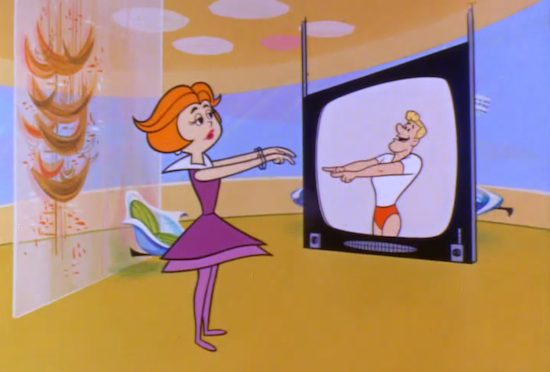
When I was a child, my brothers and I loved watching The Jetsons. The antics of the eponymous futuristic family were highly entertaining. I distinctly remember the episode in which Mrs. Jetson had to be treated for 'button pushing disease.' Everything in her life was performed by the push of a button. We laughed uproariously! Can you imagine? Button-pushing disease! Hahahahaha!
Jane Jetson doing Jack Lalane-esque finger exercises in episode 1 of
The Jetsons, which first aired in September of 1962.
image: smithsonianmag.com

Well, here we are, fifty years later, and 'button-pushing disease' is an actual thing. It's called 'carpal-tunnel,' the repetitive stress from pushing buttons. This, coupled with the deleterious effects of simply not moving around much, have left us in sorry shape.

We now live in a world of unprecedented comfort. We can have pre-cooked food delivered to our homes with the push of a button. Vacuuming was the last vestige of moderately strenuous housework. Now you can buy a Roomba and (he? she? it?) will do it for you. This may be convenient, but it's not good for us.

Peeps, I know it is hard to carve out time for exercise, but we have to do it. We were born to move. It's essential.

********************************

We just got home from a week long visit with family. We did a lot of sitting. Sitting in the car. Sitting to visit. Sitting to eat (which we did a lot.) But we kicked off the trip with a drive-by visit to Physique 57 in New York City. As you all know, I *heart* Physique 57 and go whenever I can. I took a deliciously spicy Signature class with a delightful instructor. Later that day, Ashley Perez, another instructor I follow on Instagram, posted a picture of Jacqueline Nickelberry, long-time Physique 57 client, completing a #sweatyin30 challenge she had designed.

The goal of #sweatyin30, according to Ashley, is 'thirty minutes of exertion with a side of sweat.' That's it. No do-this-activity-on-that-day. No over-thinking it.

Just do some movement for thirty minutes, everyday for thirty days, working hard enough that you're getting at least a little misty. 

The blissful simplicity of this directive really struck a chord with me. I've been a fitness buff for a very long time. I've read countless articles on exercise and sifted through differing opinions over the years on the 'best' or 'ideal' way to get in shape. Some of that information is interesting and helpful, but it's easy to get caught in a kind of analysis paralysis. Fear of 'not doing it right,' or not doing 'enough,' can keep us from doing anything at all.

Over the past eighteen months or so, I have struggled mightily with injuries, aches and pains. Consequently, I have become significantly de-conditioned and I've put on weight. Every time I've tried to complete a rotation, I've gotten sidelined by something. Something with my body, something with the small people. And then I'd lose my momentum. It's been frustrating and discouraging.

But this idea of just 30 minutes... Anything for 30 minutes... I could do that.

And so I started. That day. That Physique 57 class, from which I was quite sore for several days, that was day 1. None of this 'I'll start tomorrow' nonsense.

I'm now on day 9. I've done my #sweatyin30 while traveling. I've done it after being up in the night with sick kids. I've done it on only five hours of sleep. I've done it with soreness. I'm not saying I've killed it and dragged it home on some of those really hard days. We've gotten this idea that exercise has to be punishing, but it doesn't! In fact, we really shouldn't kill it and drag it home everyday. On rough days, I've taken fairly gentle walks, I've played around in hotel pools with my kids, I've climbed stairs, I've jumped on a trampoline. The point is to do something. Anything. Just move.

And so with that verbose introduction, here are five tips I can share (you know, from the vast wisdom I have acquired in nine days of working it):

1. Do it in the morning. I know morning exercise doesn't work for everyone, but there is a lot to be said for doing it in the morning. (I don't necessarily mean the minute you get out of bed, just early in the day.) When you give it the first fruits of your day, it is far less likely to be crowded out by other things. I find if I wait too long, it becomes a chore--something hanging over my head that has to be done. I don't like thinking of exercise that way. I don't want it to become a chore, so I usually get it done in the morning.

2. Do it with other people. Personally, I like exercising alone. I'm an introvert and I enjoy the solitude, but exercising with other people has some distinct advantages. It can be more fun, motivating, and it holds you accountable. It's also efficient--catching up with friend, check! Workout--check! All at the same time.

3. Tell people about it! I committed to my #sweatyin30 on Instagram by commenting on Ashley's post. I don't even know Ashley, but I said I'd do it and that was enough to get me up and going on those rough days. There's a burgeoning #sweatyin30 community out there. Join us!

4. Accept limitations, and find creative ways to work around them. We all have limitations. Some are physical, some financial, and all of us are constrained by 24 hours in the day. I know if I wait for all the planets to be properly aligned, I'll never do it. This is my life and I have to work with what I have. Sometimes I play tag with my kids, sometimes I dance around the kitchen for thirty minutes. I prefer a dedicated workout, but it can't always happen.

If money is tight, check out the library or YouTube for free material. On my day six, I streamed a free barre workout and did it on my parents' deck. BAM! Thirty minutes. Sweat like a mad beast. Check!

5. Recognize this is going to cost you something. The Internet is rife with articles about how to do things in 'quick and easy' ways. It doesn't have to be punishing, but it might not be 'easy.' We have to get over our love affair with comfort and convenience. It's going to cost thirty minutes. It's going to cost some energy, but you'll get it back in spades.

We're not asking for blood or tears... just a little sweat.

Are you ready to get #sweatyin30?

Follow me on Instagram @momsatthebarre to see how I'm getting sweaty!

Tuesday, March 29, 2016

Should You Fire Your Maid? And Other Lessons from the Era-House

The older little and I have gotten hooked on the era-house reality shows that were made around the turn of this century. They typically involve a modern family (or three) 'going back in time' to simulate life in an earlier period. The first of this genre is 1900 House. A British family moves in to a restored late-19th century London semi-detached house and copes with all the inconveniences of life in that period, including a woefully inadequate stove, far too infrequent baths and a marginally helpful mangle.
image: wikipedia
Finally, the housewife snaps under the strain of housekeeping and employs a 'maid-of-all-work,' one of the lower members of the late-Victorian/Edwardian servant class. This type of maid was, as the title implies, responsible for taking on all manner of chores, from cooking to cleaning to laundry. This freed up the housewife to pursue other interests, such as the burgeoning women's movement and other social causes of the time. She becomes so burdened by the plight of women servants (through her research, not actual interest in the woman she's hired) that she decides she can no longer square her conscience with hiring a maid, and promptly sacks the young woman.

In a letter. Because she was too chicken to do it face-to-face.

Of course, the only reason she does this is because there is only a week left on her social experiment and she really doesn't care how dirty the house gets because they're out of there. But I couldn't help but wonder.... what would have become of such a woman? (The maid, not the housewife.)

In fact, these maid-of-all-work positions were a lifeline for poor women of the period. Uneducated and ill-trained, maids-of-all-work were pretty much one job away from the gutter. For a lower-middle-class woman to let go a hardworking maid was to consign her to a miserable fate, unless she had an excellent reference and another job lined up right away. So I'm naturally thinking, 'just give her a job and treat her with dignity!'

It's very easy to get preachy when you watch these shows from your comfortable, well-heated 21st century living room, but I find that we might be in a similar position without even realizing it.

*********************

Ever since I began my household purge using the KonMari Method, I have been pitching things left and right. How wonderful! Less stuff! YAY! The first week alone, I donated over six huge bags to charity. I have less stuff, a tax deduction, and poor people... somewhere... have the blessing of all my cast-offs, right?

Well, maybe not. Right after I finished my clothing purge, I happened upon a documentary called The True Cost. It focuses on the abuses perpetrated by the garment industry, specifically a segment of it called 'fast fashion.' This is the low-quality, mass-produced stuff you find at Walmart, Target, H&M, Forever 21, Kohl's and the like. Fast-fashion is a huge segment of the garment industry, and it's growing rapidly. The clothes are produced in third-world countries in what are basically slave-labor conditions. The toll this takes on the workers, local economies and the planet is nothing short of staggering.

The plight of these workers was highlighted a few years ago by the fire that swept through a Bangladeshi garment factory. Unsafe working conditions resulted in the deaths of over 1,000 workers. While it may be tempting to lay the blame at the feet of the factory owners (and they deserve some of it), they are trying to compete with other factories to secure the contracts of western companies.

The movie is incredibly depressing and hard to watch. And it has, in my opinion, some problems. The filmmaker blames fast-fashion for everything from environmental destruction to farmer suicides in India. I'm not saying there isn't a link, but the scope of the film is so broad, it lessens it's impact. It's like drinking from a fire hose. After a while, you just shut down.

It's also long on problems and short on solutions. Clearly, avoiding mindlessly buying stuff from Walmart just because it's cheap is a start, but even better retailers outsource their manufacturing to these countries. I started checking labels on my kids' clothes, and my son's L.L. Bean sweatshirt was made in Cambodia, one of the places garment workers have clashed with police over wage disputes.

***************************

I remember when I first read 'made in Bangladesh' on a clothing label. I felt really glad. Knowing what a poor country it is, I thought how great that my t-shirt is providing a job for someone in Bangladesh! Awesome! It was the same feeling I had when I'd donate clothing, but as the film reveals, many western clothing donations end up in landfills, and these donations have gravely affected the local economies of the countries to which they are sent.

So what are the answers? How do we help with this?

One thing I know I can do is to...

Stop buying cheap clothes. I am very sympathetic to the fast-fashion buyer who is cash-strapped and just needs something to wear, especially the parent who is trying to keep her kids in clothes that fit. The siren song of cheap is very alluring, particularly when it comes to children who outgrow things in a hurry. But even then, I find the cheap stuff doesn't last. I discovered holes in the knees of both my littles the other day. I'm resolving to buy better quality clothes. The L.L. Bean knees remain intact (even if they are made in Cambodia), while the pants from Target have to be patched before they can even make it down to the little darling. It's not cheap if I have to replace it for the younger child. I'm better off in every way if I just buy the good stuff the first time around.

Another is to...

Fix things!
A maxim of World War 2 Britain was 'make do and mend.' Fabric was in short supply during the war, and housewives were tutored by a fictional character called Mrs. Sew-and-Sew.
image: paperdressvintage.co.uk
She provided lessons in how to extend the life of garments and other textiles, lessons which were sorely needed. Food, clothing and household supplies were rationed into the early 1950's. Patching and mending are easy and inexpensive ways to breathe new or longer life into clothes. Recently we had a pair of torn trousers fashioned into shorts for my husband by a local seamstress. The fact that we supported a local business was a bonus.

Stop Shopping for Recreation.
Really. Shop when we need things, not just to 'see what's on sale.'

Share.
We've been immeasurably blessed by hand-me-downs, and we love passing them on when we're done with them.

But as for the Bangladeshi worker, I don't know the long-term answers. I don't know what regular people like me can really do to make an impact on this lamentable situation. Yes, I can refuse to buy clothes with the 'made in Bangladesh' label, but am I really helping the garment worker there who has to leave her children with relatives so she can work for starvation wages? Or am I just making her plight worse, like the 1900 housewife firing her maid?

What I do know is the gluttonous consumption of the west is not helping them, and really, it's not helping us. We're drowning in things. We're not happier with more things. In every single one of these era house reality shows, the participants say they are changed. That they now enjoy having less. They acknowledge how overwhelmed we are with things. A boy in the series Frontier House, emphasized how he enjoys having fewer toys after his experience, and the children in 1940s House (the best of the genre, I'd say) returned home with no interest in their PlayStation. They were more entertained by a homemade board game.

We've been deceived into believing that more is always better, and it isn't true. Often, more is just... more.

Saturday, February 13, 2016

How to De-Stress Your Socks: The KonMari Method

About a year ago, I first heard of the KonMari Method of home organizing. It's the brainchild of Marie Kondo, a very successful Japanese organizing consultant. Kondo's first book, The Life-Changing Magic of Tidying Up, was published in 2014 and has become an international best-seller. Kondo and her method have gotten a lot of press, mostly because Kondo's ideology is.... well, a little different.

You see, the KonMari Method runs pretty contrary to most standard home organizing advice. Rather than tackling your home room-by-room, or chipping away at it little-by-little, Kondo wants you to wage war. Instead of endorsing complicated organizing systems for your stuff, she wants you to start with a purge.

Lots of people suggest you declutter, but Kondo employs a completely revolutionary criterion: joy.

Joy? Seriously? What does joy have to do with my socks? Or my potato peeler? Of course, it's 20 degrees out, so my Smartwool does make me pretty happy, but I still can't say I'm giddy about it. The whole thing just seemed waaaay too touchy-feely. Plus, the method calls for doing everything in one fell swoop. You're supposed to dump all your clothes out on the floor--all at once--and assess whether or not they 'spark joy.' This is not something you can knock out during nap time. (Obviously, Kondo didn't have little kids when she wrote this book.)

Still the most controversial aspect of the book was the talking. Kondo says you should talk to your stuff. Oh my word. Or no words. No words for my stuff.

So I dismissed the KonMari method as 'not for me.'

Fast-forward a year and my recent epiphany that I want to throw out all our stuff and move my family to an ashram, and I decide to give the KonMari method a read. I really shouldn't judge a book by what I read about it on Facebook, after all.

She begins by telling us her recidivism rate is basically zero. Apparently scads of Japanese people have taken her course, but no one needs to take it again. Her approach, which has been cultivated from her earliest OCD life experiences, is that effective. It completely changes your relationship to your stuff. But first, you must purge. Which she calls 'discarding.'

Yes! I'm thinking. I'm in!! Let's discard!! Yay! She encourages us to start with clothing. If that's too overwhelming, she suggests you break it down by category of clothing, starting with tops. Well, that's still too overwhelming, and I don't have a lot of time here, so I figure I'll start with socks. I hadn't gotten to the sock part of the book yet, but there is only one drawer of socks. I should be able to knock that out before Bob the Builder is over. Can we build it? Yes! We can!
The 'before'

The Darling Husband is packing for a business trip. He's watching me dump all the balled-up socks, packaged stockings and other flotsam and jetsam out onto the bed.

Then I start reading to him. About socks. She says, "Let me state here and now: Never, ever tie up your stockings. Never, ever ball up your socks."

She goes on:
"Look at [your socks] carefully. This should be a time for them to rest. Do you really think they can get any rest like that?
That's right. The socks and stockings stored in your drawer are essentially on holiday. They take a brutal beating in their daily work, trapped between your foot and your shoe, enduring pressure and friction to protect your precious feet. The time they spend in your drawer this their only chance to rest. But if they are folded over, balled up, or tied, they are always in a state of tension, their fabric stretched and their elastic pulled. They roll about and bump into each other every time the drawer is opened and closed. Any socks and stockings unfortunate enough to get pushed to the back of the drawer are often forgotten for so long that their elastic stretches beyond recovery. When the owner finally discovers them and puts them on, it will be too late and they will be relegated to the garbage. What treatment can be worse than this?"
We felt the socks needed a session... you know, from all the stress

At this point the Darling Husband has picked his chin up off the floor and is now doubled over laughing. He thinks Marie is looney tunes.

As Long as They Don't Talk Back...
The anthropomorphism makes KonMari a tough sell for many, especially considering the socks are just the tip of the iceberg. By the end she has you greeting your house when you come home from work and thanking all your stuff for serving you. She empties her handbag at the end of the day, you know, because it needs a break from schlepping her stuff around. She thanks it for having done such a great job and tells it to have a good rest.

As cuckoo for cocoa puffs as this all sounds, I actually don't mind it. Kondo practices the Shinto religion. In fact, she was an attendant maiden in a Shinto shrine for five years, so 'Shinto' is not just a box she checks on forms. Shintoism teaches that objects have a kama, or spirit. So talking to her things is just taking this belief system to it's logical conclusion. If that sounds off to you, I'd suggest taking it up with Shintoism, not just writing Kondo off as crazy. For her, it's an authentic expression of her beliefs.

For Japanese people, this concept of kama is understood, even if it is not necessarily believed by everyone. Since Shinto has been a dominant religion in Japan, it has influenced the culture and so Kondo's message is not as strange to them as it may be to us. I wondered how much harder it might be for people to 'discard' things they believe to have feelings and a soul. Turns out, anthropomorphizing objects is a common trait among hoarders in the West, but not so much in the East.

For me to talk to my possessions would be inauthentic and a violation of my beliefs. So no chitchat between me and the socks. I do appreciate the idea of gratitude that permeates the KonMari Method, but I'll be thanking the Giver of the things, not the things themselves.

And so, back to the socks.
Which ones spark JOY?! Well, my barre socks. Joy joy joy joy, down to my feet! Smartwool, fer shur. I mean, as joyful as I can get about socks. I kept a few fuzzy ones I wear in the evenings with my Fuzzy Blue Robe, which is the greatest joy sparking item in my wardrobe. Fuzzy Blue Robe means the SMALL PEOPLE ARE IN BED, baby!

However, the sock discarding starts to get hard when I come to the six pairs of stockings I still have in their packages. (Leaving the tags on/stockings in packaging is a big no-no with Kondo. After all, how would YOU feel if you were left in a box??) Stockings do not spark joy. Maybe if I had lived through World War 2 rationing and had to draw a seam up the back of my legs while rolling bandages for the Red Cross I would feel joy at the sight of brand-new stockings in the box, but no, not so much.

In fact, I don't even wear stockings anymore. No one does. That's why I was able to score them dirt-cheap. I figured some day I might use them, but I think I bought them ten years ago and I still haven't. Even so, I'm having trouble putting them in the donation box. Brand new stockings remind me of a time when I was poor, living in New York City making a pittance. I carried a bottle of clear nail polish in my heavily burdened handbag to stop runs because I couldn't afford new ones (cue stirring music.) How could I possibly 'discard' perfectly good stockings?! I got so stressed out over the dumb stockings that I had to take a break and do a Physique 57 video.

Finally I returned to my job and finished my sock drawer. I folded all my socks into little rectangles as Kondo recommends. See?
Ok so it's sideways, but you get the point
Now I can see all my sock options when I open the drawer! They're all just hanging out, chillaxing in there. It's nice.

Later in the week I moved on to the rest of my clothes, and I must say, I'm loving it. I gave away six huge bags of clothes and shoes. I kept only the things I really like and actually wear. I'm not a huge clothing person so I had to branch out a little from outright joy. I mean, I need more than just barre socks, my wedding dress and the Fuzzy Blue Robe, you know?

*****************************

It is interesting how tied we become to our possessions. I was surprised by how many memories I had attached to my clothes. Some I might have kept, but one of Kondo's directives is to think of the person you are becoming, not the person you were. Clothes that no longer fit or remind me of high school are not going to help with that. Kondo has a very guilt-free way of looking at these things. She says not everything is meant to be worn to the point that it's threadbare. Some things served you for a time, but they don't anymore. Better to let them go than to keep hanging on in your closet.

The delightful part, now that I'm through all the hand-wringing over the stockings, is now I have plenty of space in my closet and drawers. In fact, I was even able to move some things that I had squirreled away in other parts of my house into my closet. And still, I have extra room! Delight!

And so, yes, I'll admit....

I'm a konvert.

(pssst... I kept the stockings.)