Like most of the rest of the world, I'm glued to my TV in the evenings, watching the Olympics. Every two years (Winter and Summer games alternate) my bottom grows roots while I delight in the heroic physical feats of the world's best athletes. They're sweating and suffering and I'm just chillaxing away. Sometimes I foam roll while I watch, just to break up the sloth.
Last night, Michael Phelps won his 20th AND 21st gold medals. The man is a machine. The 200m butterfly competition included a side dish of intense public rivalry and trash talk outside the pool. Yummy! South African Chad le Clos has been goading Phelps over this particular race. He bested Phelps in 2012 to win gold in this event. Apparently avenging this loss was part of reason Phelps came out of retirement to swim again in Rio.
For some insane reason, le Clos thought it was a good idea to stir the pot with Phelps, to rub it in that he won last time and challenge Phelps to another duel. Yes, challenge the greatest swimmer (athlete, maybe?) of all time.
People, this is never a good idea. Michael Phelps is an amazing physical specimen. I'm sure he trains very hard to be as good as he is, but he is also genetically gifted. His wing span is ridiculous. He is a machine.
But sports at this level is not just about the body, it's also about the mind, and Phelps is all about the mind game. I remember he sat down with Bob Costas during one of his previous four Olympics and talked about how he psyches himself up before a race. He explained to Costas that he imagines slights from other athletes. Another swimmer might glance in his direction, and Phelps will take affront in his own mind and nurture the 'grievance,' for hours, days, weeks, months before the race. He will work himself up into an embittered frenzy and unleash his fury in the pool. Seriously, he said he does this. Yikes.
Phelps won last night's race decisively, earning is 20th Olympic gold medal. He relished in his victory, perched atop the lane divider, he urged the crowd to bring on the praise.
As for le Clos, he finished fourth, and NBC commentator Rowdy Gaines offered sage advice--"Don't poke the tiger." Words to live by.
Sadly, and unsurprisingly, Twitterland erupted with heaping shame and humiliation for le Clos. We Americans do many things well, but increasingly, tact, kindness and graciousness are nowhere on the list. We've always been chided as an arrogant people, and it seems to reach new heights everyday. Honestly, I fear for my country. Phelps has earned the right to be proud and maybe a little smug, but the rest of us? The armchair/foam roller athletes? No. Sorry.
Of course, I'm happy for Michael Phelps, but I can't help but feel sorry for le Clos. Poor guy. He's eating a massive slice of humble pie, and apparently BOTH his parents have cancer?! Good grief. Let's all give the guy a break. I just don't have the stomach or the steely heart for great athletic feats, let alone the physical capacity.
I'll just go back to my foam roller.
Wednesday, August 10, 2016

Sunday, June 5, 2016
Barre Crawl: barre3 Revisited
Lately, I've been taking classes at barre3. I reviewed one class I took there when it first opened, but I did so with some trepidation. I really don't like reviewing studios with only one class under my belt. Somehow, it doesn't seem quite fair. You need a few swigs to get a really accurate perception of a barre, and at the time I was in the tank for the Bar Method. I still really like the Bar Method, by the way. They're tops for form corrections, and the carpet... oh my. But I gave up my membership there last summer. My wonky bits were acting up too much for me to get enough use out of it, and I was ready for a change.
So color-me-happy when my local barre3 had a sale on ten class packs. Yippee! A sale on barre classes is to me what a sale on shoes is to other women.

Here are five things I'm loving about barre3:
The only thing I'm not loving about barre3 is the floor. It's hard. And the mats are rigid so you can't just fold one up and stash it near your spot for when releve is hurting your bunion. But that's ok. I can work around that. barre3 is getting two thumbs up.
So color-me-happy when my local barre3 had a sale on ten class packs. Yippee! A sale on barre classes is to me what a sale on shoes is to other women.

Here are five things I'm loving about barre3:
- I sweat. This is not usually that hard for me, as I've mentioned before. I tend to be a sweat-er. But not all barre classes will get you more than misty. Barre3 is a full-on sweat. This is because b3 always includes a set of compound exercises. You're working upper and lower body together, and it's intense.
- They use large range of motion exercises, along with the up-an-inch-down-an-inch isometric contractions for which barre is famous. Usually, a set of tiny pulses is followed by some big movements. Honestly, this just feels good after the tiny pulses. And it gets your heart rate back up. See #1.
- It's different. We all know how I feel about barre. I *heart* it to the moon and back, but sometimes it's nice to do something a little different from the standard barre workout format (arms/thighs/seat/abs.) The layout of a barre3 class is not like a classic barre class. Everything is all jumbled up. You know, in a good way. Not like my kitchen gadget drawer. Anyway, moving on...
- They are all about modifications, and that makes my heart sing. After my year of 1000 injuries, I need modifications, and I love that I am encouraged to modify up the wazoo if I need to. Every studio I've ever been to sanctions modifications if you need them, but sometimes it feels a little less-than if you are doing them. Not at barre3. They're all over making the workout work for you. And that leads me to my fave aspect of b3....
- The vibe. It's very supportive, and very non-competitive. You won't hear any of that 'see if you can get one inch lower than your neighbor' nonsense. You know what? Some people could maybe get a little lower in wide-second, but maybe they shouldn't. Not everyone's body is designed to get the femur parallel to the floor. For some people, that's an injury waiting to happen. I've now taken classes with five different instructors, and they are all about making the class work for you. On that day. Even if you're normally an amazon, if you're just not feeling it that day, that's A-OK. And that, peeps, is really nice for recovering badasses like me.
The only thing I'm not loving about barre3 is the floor. It's hard. And the mats are rigid so you can't just fold one up and stash it near your spot for when releve is hurting your bunion. But that's ok. I can work around that. barre3 is getting two thumbs up.
Monday, May 2, 2016
The Biggest Loser is STUPID
 |
| image: realitytea.com |
I used to watch the reality show Biggest Loser from time to time. I liked watching the challenges, and I'll admit I got a little choked up at all the transformations, heart-wrenching stories, etc. I was cheesier when I was younger.
In fact, BL was on the TV in the birthing room when I had my first child. I suppose I enjoyed seeing other people grunting and not looking cute and fluffy, because Lord knows, I was not so cute and fluffy at the time.
Anyway, there were always things that bothered me about that show, and the more I learned about diet and exercise, the more I grew to despise it, and now I officially can't stand it. I can't even watch it for five minutes. If you like, me no judgey, but I'm going to tell why:
I hate how they make exercise look like torture. You do not need to vomit to have a good workout. You do not need to walk on treadmills for hours on end. There is almost no joy in movement communicated to the participants on that show. They seem to do the same old same old all.the.time. Why not water aerobics? Ballroom dancing? Or even... barre?! (You knew I was going to say that.) Really, there are so many different ways to move your body. I don't understand why they persist with rope slinging, kettlebell swinging and treadmilling over and over and over. Not to mention the fact that many of these activities are really tough on the joints, and when you're dealing with the morbidly obese, joint issues should be a huge consideration. Not to mention all the emphasis on processed diet food and calorie counting. It makes me crazy.
But today I read an article in the New York Times that made me hate this show even more. It's called 'After The Biggest Loser, Their Bodies Fought to Regain Weight.' The article is heartbreaking. It chronicles the punishing regimes to lose weight fast, and the regain experiences of contestants on the horrible show's season 8, nearly all of whom regained almost all the weight they rapidly lost this stupid show.
And it's not just the season 8 contestants. If you search 'where are they now' type articles, you'll find many, many, many BL contestants have regained all or most of the weight they lost. It's just that the season 8 contestants were studied by the National Institutes of Health. They found that all the contestants had significantly slower metabolisms after participating on the show. This means they now burn far fewer calories at rest than they did before. This means they MUST eat FAR fewer calories than would be expected for people their size.
Also, since they lost so much weight so rapidly on The Stupid Show, their hormones are messed up. The contestants were found to have almost no leptin, which is one of the hormones that governs the hunger response. After regaining some weight, their leptin levels increased, but not to the previous levels they had enjoyed before The Stupid Show. This means these poor people were HUNGRY ALL THE TIME. Of course they gained the weight back! Who can resist the siren song of HUNGER?
Ok, I really need to go do some laundry, but could we please just get over the number on the scale? Please? It is SO NOT THE MOST IMPORTANT THING. SO NOT. These people would have been so much better off if the emphasis had been on small, sustainable changes, like moderate, enjoyable movement. Like eating WHOLE REAL FOOD. Like focusing on other health markers, such as blood pressure, blood sugar, heck, just ENJOYING LIFE MORE.
Even this article reveals that people are still hung up on weight, even though the maniacal focus is what seems to have permanently damaged their bodies.
The only winners of The Stupid Show are Bob Harper and Jillian Michaels, who have become household names and made money hand over fist from yelling and screaming at people. It certainly wasn't the contestants, nor the millions of people who have watched this show and tried to emulate the results. Enough.
Can we please finally get this stupid show off the air?
Sunday, April 24, 2016
Five Tips for Getting #sweatyin30
When I was a child, my brothers and I loved watching The Jetsons. The antics of the eponymous futuristic family were highly entertaining. I distinctly remember the episode in which Mrs. Jetson had to be treated for 'button pushing disease.' Everything in her life was performed by the push of a button. We laughed uproariously! Can you imagine? Button-pushing disease! Hahahahaha!
Well, here we are, fifty years later, and 'button-pushing disease' is an actual thing. It's called 'carpal-tunnel,' the repetitive stress from pushing buttons. This, coupled with the deleterious effects of simply not moving around much, have left us in sorry shape.
We now live in a world of unprecedented comfort. We can have pre-cooked food delivered to our homes with the push of a button. Vacuuming was the last vestige of moderately strenuous housework. Now you can buy a Roomba and (he? she? it?) will do it for you. This may be convenient, but it's not good for us.
Peeps, I know it is hard to carve out time for exercise, but we have to do it. We were born to move. It's essential.
We just got home from a week long visit with family. We did a lot of sitting. Sitting in the car. Sitting to visit. Sitting to eat (which we did a lot.) But we kicked off the trip with a drive-by visit to Physique 57 in New York City. As you all know, I *heart* Physique 57 and go whenever I can. I took a deliciously spicy Signature class with a delightful instructor. Later that day, Ashley Perez, another instructor I follow on Instagram, posted a picture of Jacqueline Nickelberry, long-time Physique 57 client, completing a #sweatyin30 challenge she had designed.
The goal of #sweatyin30, according to Ashley, is 'thirty minutes of exertion with a side of sweat.' That's it. No do-this-activity-on-that-day. No over-thinking it.
The blissful simplicity of this directive really struck a chord with me. I've been a fitness buff for a very long time. I've read countless articles on exercise and sifted through differing opinions over the years on the 'best' or 'ideal' way to get in shape. Some of that information is interesting and helpful, but it's easy to get caught in a kind of analysis paralysis. Fear of 'not doing it right,' or not doing 'enough,' can keep us from doing anything at all.
Over the past eighteen months or so, I have struggled mightily with injuries, aches and pains. Consequently, I have become significantly de-conditioned and I've put on weight. Every time I've tried to complete a rotation, I've gotten sidelined by something. Something with my body, something with the small people. And then I'd lose my momentum. It's been frustrating and discouraging.
But this idea of just 30 minutes... Anything for 30 minutes... I could do that.
And so I started. That day. That Physique 57 class, from which I was quite sore for several days, that was day 1. None of this 'I'll start tomorrow' nonsense.
I'm now on day 9. I've done my #sweatyin30 while traveling. I've done it after being up in the night with sick kids. I've done it on only five hours of sleep. I've done it with soreness. I'm not saying I've killed it and dragged it home on some of those really hard days. We've gotten this idea that exercise has to be punishing, but it doesn't! In fact, we really shouldn't kill it and drag it home everyday. On rough days, I've taken fairly gentle walks, I've played around in hotel pools with my kids, I've climbed stairs, I've jumped on a trampoline. The point is to do something. Anything. Just move.
And so with that verbose introduction, here are five tips I can share (you know, from the vast wisdom I have acquired in nine days of working it):
1. Do it in the morning. I know morning exercise doesn't work for everyone, but there is a lot to be said for doing it in the morning. (I don't necessarily mean the minute you get out of bed, just early in the day.) When you give it the first fruits of your day, it is far less likely to be crowded out by other things. I find if I wait too long, it becomes a chore--something hanging over my head that has to be done. I don't like thinking of exercise that way. I don't want it to become a chore, so I usually get it done in the morning.
2. Do it with other people. Personally, I like exercising alone. I'm an introvert and I enjoy the solitude, but exercising with other people has some distinct advantages. It can be more fun, motivating, and it holds you accountable. It's also efficient--catching up with friend, check! Workout--check! All at the same time.
3. Tell people about it! I committed to my #sweatyin30 on Instagram by commenting on Ashley's post. I don't even know Ashley, but I said I'd do it and that was enough to get me up and going on those rough days. There's a burgeoning #sweatyin30 community out there. Join us!
4. Accept limitations, and find creative ways to work around them. We all have limitations. Some are physical, some financial, and all of us are constrained by 24 hours in the day. I know if I wait for all the planets to be properly aligned, I'll never do it. This is my life and I have to work with what I have. Sometimes I play tag with my kids, sometimes I dance around the kitchen for thirty minutes. I prefer a dedicated workout, but it can't always happen.
If money is tight, check out the library or YouTube for free material. On my day six, I streamed a free barre workout and did it on my parents' deck. BAM! Thirty minutes. Sweat like a mad beast. Check!
5. Recognize this is going to cost you something. The Internet is rife with articles about how to do things in 'quick and easy' ways. It doesn't have to be punishing, but it might not be 'easy.' We have to get over our love affair with comfort and convenience. It's going to cost thirty minutes. It's going to cost some energy, but you'll get it back in spades.
We're not asking for blood or tears... just a little sweat.
Are you ready to get #sweatyin30?
Follow me on Instagram @momsatthebarre to see how I'm getting sweaty!
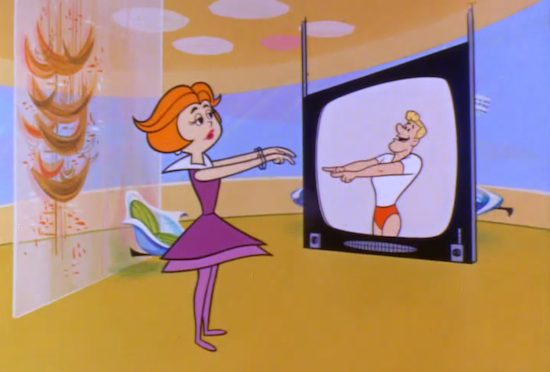 |
| Jane Jetson doing Jack Lalane-esque finger exercises in episode 1 of The Jetsons, which first aired in September of 1962. image: smithsonianmag.com |
Well, here we are, fifty years later, and 'button-pushing disease' is an actual thing. It's called 'carpal-tunnel,' the repetitive stress from pushing buttons. This, coupled with the deleterious effects of simply not moving around much, have left us in sorry shape.
We now live in a world of unprecedented comfort. We can have pre-cooked food delivered to our homes with the push of a button. Vacuuming was the last vestige of moderately strenuous housework. Now you can buy a Roomba and (he? she? it?) will do it for you. This may be convenient, but it's not good for us.
Peeps, I know it is hard to carve out time for exercise, but we have to do it. We were born to move. It's essential.
********************************
The goal of #sweatyin30, according to Ashley, is 'thirty minutes of exertion with a side of sweat.' That's it. No do-this-activity-on-that-day. No over-thinking it.
Just do some movement for thirty minutes, everyday for thirty days, working hard enough that you're getting at least a little misty.
The blissful simplicity of this directive really struck a chord with me. I've been a fitness buff for a very long time. I've read countless articles on exercise and sifted through differing opinions over the years on the 'best' or 'ideal' way to get in shape. Some of that information is interesting and helpful, but it's easy to get caught in a kind of analysis paralysis. Fear of 'not doing it right,' or not doing 'enough,' can keep us from doing anything at all.
Over the past eighteen months or so, I have struggled mightily with injuries, aches and pains. Consequently, I have become significantly de-conditioned and I've put on weight. Every time I've tried to complete a rotation, I've gotten sidelined by something. Something with my body, something with the small people. And then I'd lose my momentum. It's been frustrating and discouraging.
But this idea of just 30 minutes... Anything for 30 minutes... I could do that.
And so I started. That day. That Physique 57 class, from which I was quite sore for several days, that was day 1. None of this 'I'll start tomorrow' nonsense.
I'm now on day 9. I've done my #sweatyin30 while traveling. I've done it after being up in the night with sick kids. I've done it on only five hours of sleep. I've done it with soreness. I'm not saying I've killed it and dragged it home on some of those really hard days. We've gotten this idea that exercise has to be punishing, but it doesn't! In fact, we really shouldn't kill it and drag it home everyday. On rough days, I've taken fairly gentle walks, I've played around in hotel pools with my kids, I've climbed stairs, I've jumped on a trampoline. The point is to do something. Anything. Just move.
And so with that verbose introduction, here are five tips I can share (you know, from the vast wisdom I have acquired in nine days of working it):
1. Do it in the morning. I know morning exercise doesn't work for everyone, but there is a lot to be said for doing it in the morning. (I don't necessarily mean the minute you get out of bed, just early in the day.) When you give it the first fruits of your day, it is far less likely to be crowded out by other things. I find if I wait too long, it becomes a chore--something hanging over my head that has to be done. I don't like thinking of exercise that way. I don't want it to become a chore, so I usually get it done in the morning.
2. Do it with other people. Personally, I like exercising alone. I'm an introvert and I enjoy the solitude, but exercising with other people has some distinct advantages. It can be more fun, motivating, and it holds you accountable. It's also efficient--catching up with friend, check! Workout--check! All at the same time.
3. Tell people about it! I committed to my #sweatyin30 on Instagram by commenting on Ashley's post. I don't even know Ashley, but I said I'd do it and that was enough to get me up and going on those rough days. There's a burgeoning #sweatyin30 community out there. Join us!
4. Accept limitations, and find creative ways to work around them. We all have limitations. Some are physical, some financial, and all of us are constrained by 24 hours in the day. I know if I wait for all the planets to be properly aligned, I'll never do it. This is my life and I have to work with what I have. Sometimes I play tag with my kids, sometimes I dance around the kitchen for thirty minutes. I prefer a dedicated workout, but it can't always happen.
If money is tight, check out the library or YouTube for free material. On my day six, I streamed a free barre workout and did it on my parents' deck. BAM! Thirty minutes. Sweat like a mad beast. Check!
5. Recognize this is going to cost you something. The Internet is rife with articles about how to do things in 'quick and easy' ways. It doesn't have to be punishing, but it might not be 'easy.' We have to get over our love affair with comfort and convenience. It's going to cost thirty minutes. It's going to cost some energy, but you'll get it back in spades.
We're not asking for blood or tears... just a little sweat.
Are you ready to get #sweatyin30?
Follow me on Instagram @momsatthebarre to see how I'm getting sweaty!
Tuesday, March 29, 2016
Should You Fire Your Maid? And Other Lessons from the Era-House
The older little and I have gotten hooked on the era-house reality shows that were made around the turn of this century. They typically involve a modern family (or three) 'going back in time' to simulate life in an earlier period. The first of this genre is 1900 House. A British family moves in to a restored late-19th century London semi-detached house and copes with all the inconveniences of life in that period, including a woefully inadequate stove, far too infrequent baths and a marginally helpful mangle.
Finally, the housewife snaps under the strain of housekeeping and employs a 'maid-of-all-work,' one of the lower members of the late-Victorian/Edwardian servant class. This type of maid was, as the title implies, responsible for taking on all manner of chores, from cooking to cleaning to laundry. This freed up the housewife to pursue other interests, such as the burgeoning women's movement and other social causes of the time. She becomes so burdened by the plight of women servants (through her research, not actual interest in the woman she's hired) that she decides she can no longer square her conscience with hiring a maid, and promptly sacks the young woman.
In a letter. Because she was too chicken to do it face-to-face.
Of course, the only reason she does this is because there is only a week left on her social experiment and she really doesn't care how dirty the house gets because they're out of there. But I couldn't help but wonder.... what would have become of such a woman? (The maid, not the housewife.)
In fact, these maid-of-all-work positions were a lifeline for poor women of the period. Uneducated and ill-trained, maids-of-all-work were pretty much one job away from the gutter. For a lower-middle-class woman to let go a hardworking maid was to consign her to a miserable fate, unless she had an excellent reference and another job lined up right away. So I'm naturally thinking, 'just give her a job and treat her with dignity!'
It's very easy to get preachy when you watch these shows from your comfortable, well-heated 21st century living room, but I find that we might be in a similar position without even realizing it.
Ever since I began my household purge using the KonMari Method, I have been pitching things left and right. How wonderful! Less stuff! YAY! The first week alone, I donated over six huge bags to charity. I have less stuff, a tax deduction, and poor people... somewhere... have the blessing of all my cast-offs, right?
Well, maybe not. Right after I finished my clothing purge, I happened upon a documentary called The True Cost. It focuses on the abuses perpetrated by the garment industry, specifically a segment of it called 'fast fashion.' This is the low-quality, mass-produced stuff you find at Walmart, Target, H&M, Forever 21, Kohl's and the like. Fast-fashion is a huge segment of the garment industry, and it's growing rapidly. The clothes are produced in third-world countries in what are basically slave-labor conditions. The toll this takes on the workers, local economies and the planet is nothing short of staggering.
The plight of these workers was highlighted a few years ago by the fire that swept through a Bangladeshi garment factory. Unsafe working conditions resulted in the deaths of over 1,000 workers. While it may be tempting to lay the blame at the feet of the factory owners (and they deserve some of it), they are trying to compete with other factories to secure the contracts of western companies.
The movie is incredibly depressing and hard to watch. And it has, in my opinion, some problems. The filmmaker blames fast-fashion for everything from environmental destruction to farmer suicides in India. I'm not saying there isn't a link, but the scope of the film is so broad, it lessens it's impact. It's like drinking from a fire hose. After a while, you just shut down.
It's also long on problems and short on solutions. Clearly, avoiding mindlessly buying stuff from Walmart just because it's cheap is a start, but even better retailers outsource their manufacturing to these countries. I started checking labels on my kids' clothes, and my son's L.L. Bean sweatshirt was made in Cambodia, one of the places garment workers have clashed with police over wage disputes.
I remember when I first read 'made in Bangladesh' on a clothing label. I felt really glad. Knowing what a poor country it is, I thought how great that my t-shirt is providing a job for someone in Bangladesh! Awesome! It was the same feeling I had when I'd donate clothing, but as the film reveals, many western clothing donations end up in landfills, and these donations have gravely affected the local economies of the countries to which they are sent.
So what are the answers? How do we help with this?
One thing I know I can do is to...
Stop buying cheap clothes. I am very sympathetic to the fast-fashion buyer who is cash-strapped and just needs something to wear, especially the parent who is trying to keep her kids in clothes that fit. The siren song of cheap is very alluring, particularly when it comes to children who outgrow things in a hurry. But even then, I find the cheap stuff doesn't last. I discovered holes in the knees of both my littles the other day. I'm resolving to buy better quality clothes. The L.L. Bean knees remain intact (even if they are made in Cambodia), while the pants from Target have to be patched before they can even make it down to the little darling. It's not cheap if I have to replace it for the younger child. I'm better off in every way if I just buy the good stuff the first time around.
Another is to...
Fix things!
A maxim of World War 2 Britain was 'make do and mend.' Fabric was in short supply during the war, and housewives were tutored by a fictional character called Mrs. Sew-and-Sew.
She provided lessons in how to extend the life of garments and other textiles, lessons which were sorely needed. Food, clothing and household supplies were rationed into the early 1950's. Patching and mending are easy and inexpensive ways to breathe new or longer life into clothes. Recently we had a pair of torn trousers fashioned into shorts for my husband by a local seamstress. The fact that we supported a local business was a bonus.
Stop Shopping for Recreation.
Really. Shop when we need things, not just to 'see what's on sale.'
Share.
We've been immeasurably blessed by hand-me-downs, and we love passing them on when we're done with them.
But as for the Bangladeshi worker, I don't know the long-term answers. I don't know what regular people like me can really do to make an impact on this lamentable situation. Yes, I can refuse to buy clothes with the 'made in Bangladesh' label, but am I really helping the garment worker there who has to leave her children with relatives so she can work for starvation wages? Or am I just making her plight worse, like the 1900 housewife firing her maid?
 |
| image: wikipedia |
In a letter. Because she was too chicken to do it face-to-face.
Of course, the only reason she does this is because there is only a week left on her social experiment and she really doesn't care how dirty the house gets because they're out of there. But I couldn't help but wonder.... what would have become of such a woman? (The maid, not the housewife.)
In fact, these maid-of-all-work positions were a lifeline for poor women of the period. Uneducated and ill-trained, maids-of-all-work were pretty much one job away from the gutter. For a lower-middle-class woman to let go a hardworking maid was to consign her to a miserable fate, unless she had an excellent reference and another job lined up right away. So I'm naturally thinking, 'just give her a job and treat her with dignity!'
It's very easy to get preachy when you watch these shows from your comfortable, well-heated 21st century living room, but I find that we might be in a similar position without even realizing it.
*********************
Well, maybe not. Right after I finished my clothing purge, I happened upon a documentary called The True Cost. It focuses on the abuses perpetrated by the garment industry, specifically a segment of it called 'fast fashion.' This is the low-quality, mass-produced stuff you find at Walmart, Target, H&M, Forever 21, Kohl's and the like. Fast-fashion is a huge segment of the garment industry, and it's growing rapidly. The clothes are produced in third-world countries in what are basically slave-labor conditions. The toll this takes on the workers, local economies and the planet is nothing short of staggering.
The plight of these workers was highlighted a few years ago by the fire that swept through a Bangladeshi garment factory. Unsafe working conditions resulted in the deaths of over 1,000 workers. While it may be tempting to lay the blame at the feet of the factory owners (and they deserve some of it), they are trying to compete with other factories to secure the contracts of western companies.
The movie is incredibly depressing and hard to watch. And it has, in my opinion, some problems. The filmmaker blames fast-fashion for everything from environmental destruction to farmer suicides in India. I'm not saying there isn't a link, but the scope of the film is so broad, it lessens it's impact. It's like drinking from a fire hose. After a while, you just shut down.
It's also long on problems and short on solutions. Clearly, avoiding mindlessly buying stuff from Walmart just because it's cheap is a start, but even better retailers outsource their manufacturing to these countries. I started checking labels on my kids' clothes, and my son's L.L. Bean sweatshirt was made in Cambodia, one of the places garment workers have clashed with police over wage disputes.
***************************
I remember when I first read 'made in Bangladesh' on a clothing label. I felt really glad. Knowing what a poor country it is, I thought how great that my t-shirt is providing a job for someone in Bangladesh! Awesome! It was the same feeling I had when I'd donate clothing, but as the film reveals, many western clothing donations end up in landfills, and these donations have gravely affected the local economies of the countries to which they are sent.
So what are the answers? How do we help with this?
One thing I know I can do is to...
Stop buying cheap clothes. I am very sympathetic to the fast-fashion buyer who is cash-strapped and just needs something to wear, especially the parent who is trying to keep her kids in clothes that fit. The siren song of cheap is very alluring, particularly when it comes to children who outgrow things in a hurry. But even then, I find the cheap stuff doesn't last. I discovered holes in the knees of both my littles the other day. I'm resolving to buy better quality clothes. The L.L. Bean knees remain intact (even if they are made in Cambodia), while the pants from Target have to be patched before they can even make it down to the little darling. It's not cheap if I have to replace it for the younger child. I'm better off in every way if I just buy the good stuff the first time around.
Another is to...
Fix things!
A maxim of World War 2 Britain was 'make do and mend.' Fabric was in short supply during the war, and housewives were tutored by a fictional character called Mrs. Sew-and-Sew.
 |
| image: paperdressvintage.co.uk |
Stop Shopping for Recreation.
Really. Shop when we need things, not just to 'see what's on sale.'
Share.
We've been immeasurably blessed by hand-me-downs, and we love passing them on when we're done with them.
But as for the Bangladeshi worker, I don't know the long-term answers. I don't know what regular people like me can really do to make an impact on this lamentable situation. Yes, I can refuse to buy clothes with the 'made in Bangladesh' label, but am I really helping the garment worker there who has to leave her children with relatives so she can work for starvation wages? Or am I just making her plight worse, like the 1900 housewife firing her maid?
What I do know is the gluttonous consumption of the west is not helping them, and really, it's not helping us. We're drowning in things. We're not happier with more things. In every single one of these era house reality shows, the participants say they are changed. That they now enjoy having less. They acknowledge how overwhelmed we are with things. A boy in the series Frontier House, emphasized how he enjoys having fewer toys after his experience, and the children in 1940s House (the best of the genre, I'd say) returned home with no interest in their PlayStation. They were more entertained by a homemade board game.
We've been deceived into believing that more is always better, and it isn't true. Often, more is just... more.
Saturday, February 13, 2016
How to De-Stress Your Socks: The KonMari Method

You see, the KonMari Method runs pretty contrary to most standard home organizing advice. Rather than tackling your home room-by-room, or chipping away at it little-by-little, Kondo wants you to wage war. Instead of endorsing complicated organizing systems for your stuff, she wants you to start with a purge.
Lots of people suggest you declutter, but Kondo employs a completely revolutionary criterion: joy.
Joy? Seriously? What does joy have to do with my socks? Or my potato peeler? Of course, it's 20 degrees out, so my Smartwool does make me pretty happy, but I still can't say I'm giddy about it. The whole thing just seemed waaaay too touchy-feely. Plus, the method calls for doing everything in one fell swoop. You're supposed to dump all your clothes out on the floor--all at once--and assess whether or not they 'spark joy.' This is not something you can knock out during nap time. (Obviously, Kondo didn't have little kids when she wrote this book.)
Still the most controversial aspect of the book was the talking. Kondo says you should talk to your stuff. Oh my word. Or no words. No words for my stuff.
So I dismissed the KonMari method as 'not for me.'
Fast-forward a year and my recent epiphany that I want to throw out all our stuff and move my family to an ashram, and I decide to give the KonMari method a read. I really shouldn't judge a book by what I read about it on Facebook, after all.
She begins by telling us her recidivism rate is basically zero. Apparently scads of Japanese people have taken her course, but no one needs to take it again. Her approach, which has been cultivated from her earliest OCD life experiences, is that effective. It completely changes your relationship to your stuff. But first, you must purge. Which she calls 'discarding.'
Yes! I'm thinking. I'm in!! Let's discard!! Yay! She encourages us to start with clothing. If that's too overwhelming, she suggests you break it down by category of clothing, starting with tops. Well, that's still too overwhelming, and I don't have a lot of time here, so I figure I'll start with socks. I hadn't gotten to the sock part of the book yet, but there is only one drawer of socks. I should be able to knock that out before Bob the Builder is over. Can we build it? Yes! We can!
 |
| The 'before' |
The Darling Husband is packing for a business trip. He's watching me dump all the balled-up socks, packaged stockings and other flotsam and jetsam out onto the bed.

Then I start reading to him. About socks. She says, "Let me state here and now: Never, ever tie up your stockings. Never, ever ball up your socks."
She goes on:
"Look at [your socks] carefully. This should be a time for them to rest. Do you really think they can get any rest like that?
That's right. The socks and stockings stored in your drawer are essentially on holiday. They take a brutal beating in their daily work, trapped between your foot and your shoe, enduring pressure and friction to protect your precious feet. The time they spend in your drawer this their only chance to rest. But if they are folded over, balled up, or tied, they are always in a state of tension, their fabric stretched and their elastic pulled. They roll about and bump into each other every time the drawer is opened and closed. Any socks and stockings unfortunate enough to get pushed to the back of the drawer are often forgotten for so long that their elastic stretches beyond recovery. When the owner finally discovers them and puts them on, it will be too late and they will be relegated to the garbage. What treatment can be worse than this?"
 |
| We felt the socks needed a session... you know, from all the stress |
At this point the Darling Husband has picked his chin up off the floor and is now doubled over laughing. He thinks Marie is looney tunes.
As Long as They Don't Talk Back...
The anthropomorphism makes KonMari a tough sell for many, especially considering the socks are just the tip of the iceberg. By the end she has you greeting your house when you come home from work and thanking all your stuff for serving you. She empties her handbag at the end of the day, you know, because it needs a break from schlepping her stuff around. She thanks it for having done such a great job and tells it to have a good rest.
As cuckoo for cocoa puffs as this all sounds, I actually don't mind it. Kondo practices the Shinto religion. In fact, she was an attendant maiden in a Shinto shrine for five years, so 'Shinto' is not just a box she checks on forms. Shintoism teaches that objects have a kama, or spirit. So talking to her things is just taking this belief system to it's logical conclusion. If that sounds off to you, I'd suggest taking it up with Shintoism, not just writing Kondo off as crazy. For her, it's an authentic expression of her beliefs.
For Japanese people, this concept of kama is understood, even if it is not necessarily believed by everyone. Since Shinto has been a dominant religion in Japan, it has influenced the culture and so Kondo's message is not as strange to them as it may be to us. I wondered how much harder it might be for people to 'discard' things they believe to have feelings and a soul. Turns out, anthropomorphizing objects is a common trait among hoarders in the West, but not so much in the East.
For me to talk to my possessions would be inauthentic and a violation of my beliefs. So no chitchat between me and the socks. I do appreciate the idea of gratitude that permeates the KonMari Method, but I'll be thanking the Giver of the things, not the things themselves.
And so, back to the socks.
Which ones spark JOY?! Well, my barre socks. Joy joy joy joy, down to my feet! Smartwool, fer shur. I mean, as joyful as I can get about socks. I kept a few fuzzy ones I wear in the evenings with my Fuzzy Blue Robe, which is the greatest joy sparking item in my wardrobe. Fuzzy Blue Robe means the SMALL PEOPLE ARE IN BED, baby!
However, the sock discarding starts to get hard when I come to the six pairs of stockings I still have in their packages. (Leaving the tags on/stockings in packaging is a big no-no with Kondo. After all, how would YOU feel if you were left in a box??) Stockings do not spark joy. Maybe if I had lived through World War 2 rationing and had to draw a seam up the back of my legs while rolling bandages for the Red Cross I would feel joy at the sight of brand-new stockings in the box, but no, not so much.
In fact, I don't even wear stockings anymore. No one does. That's why I was able to score them dirt-cheap. I figured some day I might use them, but I think I bought them ten years ago and I still haven't. Even so, I'm having trouble putting them in the donation box. Brand new stockings remind me of a time when I was poor, living in New York City making a pittance. I carried a bottle of clear nail polish in my heavily burdened handbag to stop runs because I couldn't afford new ones (cue stirring music.) How could I possibly 'discard' perfectly good stockings?! I got so stressed out over the dumb stockings that I had to take a break and do a Physique 57 video.
Finally I returned to my job and finished my sock drawer. I folded all my socks into little rectangles as Kondo recommends. See?
 |
| Ok so it's sideways, but you get the point |
Later in the week I moved on to the rest of my clothes, and I must say, I'm loving it. I gave away six huge bags of clothes and shoes. I kept only the things I really like and actually wear. I'm not a huge clothing person so I had to branch out a little from outright joy. I mean, I need more than just barre socks, my wedding dress and the Fuzzy Blue Robe, you know?
*****************************
The delightful part, now that I'm through all the hand-wringing over the stockings, is now I have plenty of space in my closet and drawers. In fact, I was even able to move some things that I had squirreled away in other parts of my house into my closet. And still, I have extra room! Delight!
And so, yes, I'll admit....
I'm a konvert.
(pssst... I kept the stockings.)
Wednesday, January 27, 2016
Lose the Stuff, Find the People
Like many people in the Boston area, I live in an older home. By 'older' I mean we don't have walk-in closets, a dedicated mudroom or a custom built-in study area for our children like you'll see in fancy new construction.
Our house was built in the 1930's. The original house consisted of a living room, small kitchen and dining room, two bedrooms, a bathroom and a screened-in porch. One of the bedrooms is a good size, but the other is pretty small.
Over the years, different owners have made modifications to the house. The footprint hasn't changed, but the attic space was enlarged to accommodate two more bedrooms, a bathroom and a small sitting room, so it is not an uncomfortable size for our family of four.
Still, I love peeking in the downstairs bedroom closets. The larger room we use for guests, and this is the closet:


As you see, I'm using it mostly for pillow storage (which is ridiculous, I know. How many pillows do we need?!) But when I consider the fact that this little closet stored ALL the hanging garments belonging to a married couple, it blows my mind. I am no clothes horse, but you couldn't fit my workout-wear alone in this little number. I'm guessing Mrs. Originalowner must have had three dresses--two she rotated during the week and a nice one for Sundays.
*******************************
I've been trucking along little by little in the A Bowl Full of Lemons 14-week organizational challenge, and I've made some nice progress. I found a great way to organize our deep freezer, which is such a relief. It's too cold to be digging around in that thing trying to find the bacon. And I finally figured out a way to keep our food containers tidy.
But the more I 'organize,' the more I realize a key thing: we have too much stuff. The reason organizing is hard is because we have too much to organize. It's not that our house is too small. It's that we have TOO MUCH STUFF. We can't even use it all. It's ridiculous.
And I know I'm not alone. The size of the average American home has nearly tripled since 1950, while the size of the average family has halved. Certainly, bigger homes mean some degree of increased comfort, but they also spell bigger closets, more cupboards and, at the very least, more floor space to fill. Stuff comes at a cost--not just what you spend to buy it. You have to maintain it, power it and store it, not to mention the relational cost.
A 2006 story about big houses on NPR notes the following:
"The big house represents the atomizing of the American family," says [John Stilgoe, a professor of landscape history at Harvard University.] "Each person not only has his or her own television — each person has his or her own bathroom. Some of these houses are literally designed with three playrooms for two children. This way, the family members rarely have to interact. And the notion of compromise is simply out one of the very many windows these houses sport."
Recently I came to the painful realization that a significant amount of my time is spent managing our possessions. I spend a lot of time washing things, cleaning things, looking for things, organizing things and putting things away. I'm exhausted by it. Many days I spend more time with our stuff than I do talking to, or playing with, my children. And that, people, is sad.
I joined the A Bowl Full of Lemons challenge group on Facebook for a little inspiration and motivation. There are lots of pictures of clean, beautiful, organized spaces, and more than a few posts lamenting the perceived deficiencies of the posters' homes. But today, I read my favorite. A woman posted a picture of her darling little nugget holding a half-eaten cookie. She wrote, "I am really starting to notice that I have more time in my day now that I'm not always shuffling around my clutter. Now that my kitchen, pantry, and dining area are clean and clutter-free I finally had the time and patience to let my 2 year old help bake cookies with me today."
I can tell you from vast and painful experience that a tremendous amount of patience is required to bake with a two-year-old. And yet this mother found it... when she lost the stuff. Hurrah!
Subscribe to:
Posts (Atom)