Sunday, April 26, 2015

Bottoms Up! If Barre Classes Were Drinks

Barre studios have become *quite* prolific. So many have been opening in my area and I've checked out a few on my travels. I'm delighted to see barre really catching on nationally and globally. While I have my favorites, I find what works for one person might not work for another. We all have our preferences and priorities, and I think there is probably a barre for everyone.
Image: pageresource.com

Before I start, a few disclaimers: this is primarily based on live studio classes I've attended. I'm also mentioning online/DVD offerings. I've taken a lot of classes at some studios, and just a few at others.

And so, in no particular order, here's the barre mom's definitive guide:


A fine, rich cabernet sauvignon served in a beautifully appointed bar with a very attentive bartender making certain you are swirling your glass with just the right turn of the wrist and consuming it in the most effective manner.
Image: foodnetwork.com

As I mentioned in my review, TBM instructors are top-notch and very attentive. They will make sure you are getting the most out of your trip to the barre. This is very important to me and it's the main reason TBM is one of my top picks.

The Bar Method has been around for a long time, but growth has been at a measured pace, largely I suspect because of the long training period required of instructors. They're big on quality control. TBM offers several DVDs and has a large and growing library of online workouts with a variety of subscription options. I'd say the online workouts are on par with classes in terms of difficulty. I don't do the online workouts, however. I'm into TBM for the live instruction. It's not the cheapest workout around, but you get what you pay for. I give TBM an A for accessibility.

You might like Bar Method if: 

  • You prize really great, personalized instruction. They've got your back. Trust me.


  • You're a newbie. Since the workout tends to be slower-paced and ultra form-focused, it's great for beginners.


  • You're more experienced and, consequently, you're not getting a whole lot of love at other studios. Instructors naturally focus much of their attention on students newer to barre, and that's totally understandable. Making sure the newer students have a sound grasp on good form is important. But more experienced students need some extra challenge to progress, too. I find TBM to be great in this respect.

You might not like TBM if:

  • You like to fly under the radar. It's standard practice to call out form corrections at The Bar Method. I actually appreciate this because it means we can all benefit from one another, but I know some people don't like this. One person who's done TBM in another state told me she cringed out of fear that they'd call her out. If you like private correction, or to walk in and walk out without being noticed, TBM might not be the be the barre for you.


  • You like a lot of variety. Bar Method classes do tend to be a little same-same. You'll see certain exercises quite frequently--some every class. 


  • You're looking for some cardio. Bar Method classes are strictly for 'toning.'(I hate that word, but that's for another post.) Stretches tend to be brisk and there is little heart-rate elevation going on here. There is a 'Bar Move' class offered at some locations, but it hasn't come to my local yet. Apparently the moves are sequenced to give a little cardio boost. I'll try it one of these days and let you know what I think.

Image: physique57.com
A mojito, made with the best, most expensive rum, and depending on who is teaching, you might find an umbrella in that drink.
Image: dreamstime.com

P57 is very fast-paced. The tempo definitely brings the challenge level up a few notches. Instructors are uber-engaging and sometimes downright entertaining. P57 doesn't have a lot of studios (only in NYC, The Hamptons, LA., Dubai and now Bangkok), but they have DVDs and super pricey online workouts.

You might like P57 if:

  • You find the average barre workout too slow or boring and you like to get some serious cardio/sweating along with your strength training. You will sweat at Physique. If you're not, you're either not a sweat-er, or you're not doing it right.


  • You're more advanced and want some killer class options. Yes, Physique has options, which is so nice. In addition to the signature class (which comes in beginner, mixed, intermediate and advanced), there is pilates-inspired Mat, more advanced Formula 57 and a variety of special workshops and themed classes. 


  • You like a high fun factor in your workouts. Oh my, Physique is so fun! I mean, fun in a very challenging sort of way. Most of the instructors are performers of one sort or another, so they are often quite entertaining. This can also up the challenge level--try to hold a forearm plank while Tanya Becker or Neil Totten are cracking jokes. Whoa.


  • You have plenty of cash and are willing to spend it on your workouts. The price tag is STEEP. More on that later.

You might not like P57 if:

  • You're a beginner and are just learning the ropes. I cut my teeth on P57, so starting here certainly can be done, but even beginner classes at the studios move quickly and it can be tough to keep up. For me, I needed the fast pace to keep me interested, but it's not for everyone.


  • You prefer a more serene, 'meditative' workout. The stretching can be serene, but that's about it. Otherwise it's a pumping beat and go-go-go!


  • You don't live in a studio location, you don't have pots of dough, and you've burned out on their limited selection of DVDs. P57 launched online workouts at a hefty $57 per month. They've only released a handful of streaming workouts for that sky-high price, though there are a few more in the pipeline. As much as I love P57, they get a C for accessibility.

Even with those cons, I can't deny that Physique 57 is still my all-time fave. I've been known to go to rather extreme lengths to take classes there (see here and here.) I *heart* Physique 57. <sigh>

Ok, moving on...

A green smoothie served up in a perfectly aligned glass. Founder Jill Dailey is a kinesiologist who puts a lot of focus on proper alignment and form. You can read my review here.
Image: poweroffood.com

You might like TDM if:

  • You're a west-coaster. TDM is best represented in the wild west of the USA, though they have studios in other cities and even a couple of international locations.


  • You have specific injuries or other need for modifications. I really haven't found other barre brands to be problematic for me, but TDM does pride itself on being uber-safe, and some of the exercises have a slightly different spin. I've only taken a few TDM classes, but typically found the instructors very attentive and knowledgeable.


  • You need childcare. Certain locations offer childcare at some classes. Check your local listings.

You might not like TDM if:

  • You don't live near a studio. They don't offer streaming service and only have two DVDs, which I have heard are effective but pretty boring. I've never tried them, though. For this reason, I'd give TDM a B- for accessibility.


Independent studios 
New England local Smuttynose Pumpkin Ale. 
A micro-brew beer infused with local character.

I don't typically review local, independent studios since my readership is scattered to the four winds, but forsake not your local indie! There are some real gems out there that may not be affiliated with well-known national barre brands. A nice local in my area is Modern Barre in Chestnut Hill, MA. I've also heard good things about the Hilliard Studio Method in Charlotte, NC, but I've never tried it. Someone please do and report back.

DC locals might want to check out Biker Barre on Capitol Hill, which offers spin and barre classes. Again, never been, but I know some regulars and they love it. It's on my list. And really, who can resist such an awesome name?

I also love the DVDs put out by The Ballet Physique in Colorado, though I've never been to a live class. We flew through Denver last year and I confessed to the Darling Husband that I was hoping for an overnight snow delay so I could try a class. (He didn't seem to share my enthusiasm for that plan.) When I travel, I love checking out different studios. Why eat at Chili's when you can try out a local taqueria? (Burr Leonard is cringing at that comparison, but hey, it's better than KFC!)

You might like indie studios if:

  • You crave variety. Independents aren't constrained by the corporate guidelines to which franchised studios have to conform. Instructors often have the freedom to choose different music and try exercises you might not see in other classes. Modern Barre offers different class programming--a high-intensity interval training and a cardio barre class in addition to the signature barre offering. Owner Julia Williamson ends each barre class with a lavender aromatherapy cool down which is delightful--and trademarked. I mean, really trademarked. (Not like I trademark things.)

You might not like independents if:

  • Obviously, the pros and cons of independents are highly variable, but you might find local studios have a sparse schedule compared to the big names. But really, it depends. Again, check your local listings.


Image: exhalespa.com

Fresh and bubbly, and definitely chug-worthy, a trip to Core Fusion will leave you lalala just like champers with a splash of OJ.
Image: blogs.dallasobserver.com

Like Physique 57, Core Fusion caters to a posh crowd. Studios are located in the most upscale neighborhoods of a few major cities, plus some resort locations. In short, where there are rich people. CF was one of the first off-shoots of the original Lotte Berk Method. Like P57's Tanya Becker, CF founders Elisabeth Halfpapp and Fred DeVito worked at LBM's New York City studio before it shut it's doors in 2005. CF classes are offered in conjunction with exhale spas (yes, the 'e' is lower case.)

CF also has a few DVDs. They are very reasonably-priced, though somewhat different and not nearly as challenging, in my opinion, as the live classes. CF gets a B+ for accessibility.

You might like CF if:

  • You're looking for a special occasion barre. It's a treat to go to CF. Studios are very serene. Mother's Day is coming up (*hint hint) and wouldn't it be nice to go downtown to exhale Core Fusion, take a class and get some sort of yummy spa delight afterwards while you watch the kids and do the breakfast dishes? Why yes, Darling Husband, it would. Thank you for asking!


  • You like options. CF offers several regular classes. In addition to traditional barre, there is yoga, Sport and Bootcamp (which you can read about here, here and here.) I've never tried the yoga, because yoga is really not my thing, but the variety is nice.

You might not like CF if:

  • You live in the burbs and/or don't have money falling out of your wallet. CF is sorta fancy. In truth, barre tends to be fancy. This isn't Planet Fitness, but you get what you pay for. I mean, you'll never find free pizza at a barre studio, but facilities at Core Fusion are really lovely and instruction is great.
= Starbucks
Image: starbucks.com

This was probably my easiest drink comparison. Like Starbucks, Pure Barre is pretty much everywhere. It is by far the most prolific barre brand with well over 200 studios throughout the United States and they're expanding into Canada. There is a pretty consistent format to PB workouts and the verbiage is the same no matter where you go. The warm-up is also the same in every studio and changes every three months. Instructors then have a menu of exercises to choose from for the other components of the class. PB studios are independently owned, so classes are not transferable from studio to studio, but if you're travelling and attend another studio, you'll notice it's quite similar to home. (Read my review here.)

PB has a handful of DVDs. Not many, but a few. No streaming yet. DVDs are not available everywhere and are on the higher end of DVD pricing. But there are studios all over the place, so I'd give PB an A for accessibility.

You might like PB if:

  • It's convenient, and it probably is. My local offers many class times throughout the week, and the owner of my local also owns the studio in the neighboring town, so in this case, I can go to either location depending on what best fits my schedule.


  • You like consistency. As mentioned, the format and cueing are pretty much the same wherever you go. They do change up some of the exercises, so you don't get a whole lot of repeat moves, apart from the warm up/arms segment in the beginning.


  • You're looking for friends, not just a workout. This may not be true of all PB locations, but at my local, they really do foster a nice sense of community. They do special challenges and events from time to time, like the Plank Off that I participated in last summer. They have a 'Bring on the Men' event a few times a year, during which women are encouraged to bring husbands, boyfriends, brothers, etc. (I haven't been able to sell this kind of thing to my Darling yet, but you never know.) This might be largely due to my local owner's personality--she's very warm and friendly and very open to feedback. PB can be a nice place to make new friends.

You might not like PB if:

  • You're looking for very attentive, engaging instruction, or advanced options. I've found PB instructors to be kind of hit-or-miss. Some are really on it, while others seem to just roam around the room. Also, the degree of difficulty can vary widely. I've taken some classes that were quite manageable and others that were wicked hard. And since there is only one class type, you don't really know how it's going to be until you're in the middle of it.


  • You're brand new to barre. I've brought a few barre virgins to PB and they've typically found it a little frustrating. Like Starbucks, PB definitely has it's own lingo, so if 'box out your arm on the barre' doesn't mean anything to you, you might find PB frustrating until you learn to speak their language. This can be mitigated by alerting the instructor that you're new. Lots of people got their releves wet at PB, so I'm not saying it's a bad place to start, just not the best, in my opinion.


= a long island iced tea served in a sippy cup.
Image: babygizmo.com

Barre3 is a mix of a lot of different elements--barre, yoga, pilates, compound moves and it really caters to the Mommy crowd. They are expanding their studio business, and they have a very robust online streaming service, as well as DVDs, a print book and a mobile app. Barre3 definitely gets an A+ for accessibility. (Class review here.)

You might like barre3 if:

  • You need childcare. Barre3 offers it for some classes, and may God bless them for it.


  • You're looking for something a little different. This is not your standard barre class. B3 throws a lot of different elements into the mix and can make for a nice change if you need a break from up-an-inch-down-an-inch.


  • You are looking for a cardio component. The compound moves in barre3 definitely get your heart pumping.

You might not like barre3 if:

  • You don't like lots and lots of reps. I only took one class at barre3 so I'm reticent to criticize anything, but there were LOTS of reps and the instructor said that was typical. So, FYI.


  • You're looking for a serene, calming experience. I didn't find barre3 to be serene. But I don't really need that in a workout. Just my bed. I need my bed to be serene.


***********************

So there you go, that's my take on the barre scene. The more I talk to other barre devotees, the more I see that convenience and location are the key factors that drive people's choices. A studio that's affordable and easy to get to is pretty key. Obviously, not all studios can be all things to all people, and working out is something you really need to do a few times a week. So that's a huge consideration. But people like different things. I like it when an instructor is all up in my grill; others find that off-putting. Some are looking for social connection; others just want to get in and get out.

I slogged through a lot of hard classes and, even more importantly, drank A LOT to bring you this in-depth report. It was tough, but I live to serve. Bottoms up!

Tuesday, April 7, 2015

I'll Take the Local: Why Supporting Small Farms Helps Us All

The state of California is in the midst of a terrible drought. Even in a good year, California weather is weird to me as an east coaster. It never rains in the summer. Californians are entirely dependent on winter rain to fill their reservoirs, and this past winter was a very dry one. Governor Jerry Brown has implemented a mandatory water reduction strategy--for the first time ever in the state's history.

Californians are taking short showers, but what does that mean for the rest of us? Higher food prices, apparently. We get an absolutely ridiculous amount of food from California. Something like 80% of the tomatoes Americans eat come from this one state. Yes, the one that's WAY over there. Granted, it's a big state, but still. It's FAR from where I live. I could fly to Reykjavik in less time than it takes me to get to California.

Something's Fishy

It strikes me as insane how much of our food comes from really far away. I recently heard on NPR that the US exports something like 90% of the fish we catch, and we import 80% of the fish we eat. Or maybe it's the reverse--90% import/80% export. I can't remember. Either way, it's INSANE.

And while we're talking crazy, get this: much of the cod fish in local markets is from ICELAND.

WHY???? I live an hour away from a place called CAPE COD. A friend of mine, a Boston local who is one of five children, told me they ate tons of cod when she was growing up because it was local and thus, cheap. Apparently this is no longer the case. We've decided, fuel shortages and all, that we should send our cod to heaven-knows-where and instead ship in cod from a small country 2,500 miles away. At least it's closer than California.

And so, like any good modern American, I shall shake my fist and demand to know,

WHO IS RESPONSIBLE?!

Earl Butz, that's who.
www.laprogressive.com

Butz was Secretary of Agriculture under President Nixon. His task was to lower food prices, which had been rising in recent years. Butz responded with a series of initiatives that favored large farms and punished the small ones. He is famous for telling farmers, 'Get big, or get out.'

The result of these policies was the closure of hundreds (thousands?) of small family farms. We started importing our food from ridiculously far away places. Like California. And Iceland.

About 20 years ago, I visited a college friend at her home in rural Vermont. As we drove around, she pointed out dozens of small dairy farms that had closed. Vermont was once known for it's dairy farms, now it's more famous for leaf-peeping. Butz's policies were devastating for rural agricultural communities that didn't hop onto his 'get big' bandwagon.

The problem with consolidating our food supply as we have is that we are basically up a (dry) creek without a paddle when something like a drought occurs. If we don't nurture our small, local farms, could we end up with something like an Irish potato famine?? Maybe. And good grief, all the fuel we use to ship these tomatoes and cod fish to and fro... it's so inefficient.

Of course, I am not insensitive to the fact that I live in a cold, densely populated area with a relatively short growing season. Late winter and early spring would be pretty lean months if we relied solely on local foods. But if we support our farms, ranches and fishermen, our resources would undoubtedly be more robust. It might still be sparse by March, but by then, the maple sap is flowing freely so we could at least slurp on syrup for a while. Yay!

Local food is fresher and so much yummier than far-away fare. The produce we get from our wonderful CSA, Picadilly Farm in New Hampshire, stays fresh SO MUCH LONGER than anything I buy from the supermarket.

Wow, I'm REALLY getting a lot of use out of the caps lock button today, but buying local just makes sense. We can leave the Icelanders with their cod, and maybe next winter arrange a snow-for-tomatoes exchange with California??

************************

You can find local foods at farmer's markets and some supermarkets, but the best place is directly from the farms. Check out www.eatwild.com  and www.localharvest.org for a list of local farms in your area.

Saturday, March 28, 2015

All About GMOs

A few months ago, Jimmy Kimmel's people quizzed pedestrians in LA on the subject of gluten, footage of which made for a great intro to this post on gluten. Now, he's tackled another health topic in the same way. This time, farmer's market shoppers were asked about GMOs.

Watch this:


Dude! Those GMOs are giving up not-so-good vibrations.

A couple of weeks ago, I attended a presentation at Boston's Museum of Science on GMOs. I found it to be very fair and evidence-based, and it's a topic on which I have been reading for some time. Here's what I've learned (and of course, my spicy opinions thereon.)

What are GMOs?

GMO stands for genetically-modified organisms. This refers to foods that have been altered using genetic engineering techniques. Basically, they splice bits of DNA strands into the DNA strands of something else. Sometimes they'll use DNA from the same type of plant (as with wheat), other times they'll use other species entirely.

Scientists tinker with genes for a variety of reasons. Some genetic engineering efforts are meant to make plants more resistant to pests. Others are meant to 'improve' the nutrient quality or simply appeal to buyers' preferences.

For example, I recently read about a scientist who is trying to modify tomatoes to make them richer in folic acid, a nutrient shown to prevent birth defects. Pregnant women are now advised to supplement their diets with folic acid, and this new-fangled tomato would undoubtedly find it's way into tomato sauces for pizzas and other processed tomato foods. And since people eat a lot of pizza, the theory is this will aid in preventing birth defects.

I heard of another effort to create peach flesh that would pull away easily from the pit. I'll admit I do find it very satisfying when my peach willingly parts with it's pit... I don't know that I need a team of researchers to finagle this for me, but well... I'll save that for my rant.

Should you avoid genetically-modified foods?

[inhaling deeply] Ok... there have been studies done on the safety and nutrient content of genetically-modified foods which indicate they are safe and as nutritious as the natural kind. However, it should be noted that these studies are usually funded by the companies that develop, sell and profit from GMOs. It is difficult to find independently-funded studies on GMOs.

How do you know a food has been genetically-modified?

Here's the sticky wicket--you don't. Food companies are not required to include this information on the label, so they don't. But something like 90% of corn, soy and canola grown in the United States are genetically modified. These crops are used in some form in almost all the processed foods sold in supermarkets, and they are used to feed livestock, even though some of those animals are not meant to be eating those foods in the first place. (Think cows -- they're supposed to be eating grass, not corn.)

Generally, unless a label specifically indicates that it does not contain genetically-modified ingredients, you should assume it does. Of course, this doesn't help you if you are buying food that doesn't come with a label, but I have also read that produce SKUs that start with '8' indicate a food has been genetically modified or irradiated. The USDA Organic label prohibits genetic modification, so buying certified organic should be GMO-free.

There is a movement afoot to require GM foods to be labeled as such, and it is being fought tooth and nail by the industry. They say it will unfairly bias consumers against their products. There is one very large company that is at the forefront on genetic engineering research. This company does not hesitate to bring legal action against anyone who threatens their business. They've sued small farmers as well as municipalities that have voted to require GMO labeling. They also produce fertilizers and pesticides. I don't want to mention them by name because I'm afraid they might sue me. But their name starts with an 'M' and rhymes with 'ronranto.'

I first heard about GMOs when I was living in Scotland back in the late 1990's. There a Hungarian-born scientist by the name of Arpad Pusztai was conducting experiments with genetically modified potatoes. Pusztai caused an uproar when he revealed in a television interview that the rats fed GM potatoes demonstrated stunted growth and supressed immune systems, and he highlighted the need for further testing.

Image: www.news.bbc.co.uk
Pusztai was summarily silenced, fired and essentially black-balled from his profession. Since then, numerous suits have been brought against pretty much anyone who threatens their interests.

And this is what really chaps my hide about GMOs. If they are so wonderful and so safe and so nutritious, why wouldn't you want to label them as such? 

I mean, really, people?? If the tomato sauce on this otherwise crappy tasting frozen pizza could save millions of babies from developing spina bifida, wouldn't we want to brag about it? When's the last time any American industry said, 'wow, let's NOT tell the people how awesome we are?'

Never. That's never happened. So if GMOs are the best thing since sliced bread made from semi-dwarf wheat, why be all hush-hush about it?

And that, dear readers, is why I smell a rat when it comes to GMOs. Why all the secrecy, the bullying? The lawsuits? Why doesn't Ronranto-with-an-M and others divert some funds from their legal departments over to PR? Why not invest in educating the public on how wonderful it is to play with DNA instead of tormenting anyone who dares cross them?

Completely avoiding GMOs is nearly impossible, but we try to limit our exposure. Our wonderful CSA produce is organic, and we buy very few processed foods. Until this industry responds to concerns with something more than legal bullying, they can expect a suspicious consumer, labeling or not.

Saturday, March 14, 2015

Life is a Marathon, Not a Sprint

It's been a rough, snowy winter here in Boston, but if you go out early on a weekend morning--despite the cold and the snow banks--you'll see runners. Lots of them. Many (maybe most?) are training for the famed Boston Marathon, which runs right near my house.

Boston is considered the holy grail for distance runners. Qualifying for it is not easy, but one athlete with her eye on the prize is my friend Pru.

Prudence Lau is my cyber-friend. We cyber-met on Twitter because of our mutual love for Anthony Howell. Let's just take a moment....
Always so nice to see him, don't you think?
Source: twitter

Anyway, Prudence started reading the blog and commenting, then we started corresponding and now we're friends. Friends who have never met in real life, but friends all the same.

Pru is a badass marathoner. In fact, she was running her third marathon in a year while I was blogging on my couch in the fuzzy blue robe about the importance of rest. She's a little cray-cray, but that's part of her charm.

I was thinking of her the whole time I was blogging about rest. Not just because she was careening through the streets of Toronto while I was 'resting,' but also because Prudence has a very interesting personal story, and she employs a very well-thought-out training protocol that includes, among other things, rest. One may say she is very... prudent. (Couldn't resist.)

And so she graciously consented to be interviewed for the blog about all these things and more. I get to pretend to be a hard-hitting journalist (HHJ) and I don't even have to interview myself like I did last time! Yay! Here we go:

HHJ: So, tell us how you got into distance running.

PruIt all started with a medical mistake. I was given an incorrect dosage of medication, which resulted in significant hearing loss. It happened suddenly, and I was left permanently deaf in one ear and with only 20% hearing in the other. 

I never recovered, not even with a high dose of the steroid Prednisone. I don't remember much from the six weeks I was on it. My husband Trevor said I was hell on wheels. All I remember was weaning off that terrible medication and opening my kitchen cupboards to find half of my dishes gone. Trevor said I'd smashed them during my anger fits.

HHJ: Oh wow. I would be so wicked pissed if I were you.

Pru: Yeah, this is where running comes in. I was so angry, depressed and frustrated. I started to run - because it's very freeing. It was such a release. And it makes me happy - endorphins!  

HHJ: Oh yes, we love endorphins! We call them 'lalas.'

Pru: Yes, running gives me the lalas, definitely. And it has taught me so much. I've learned to rely on other senses -- feeling and sight. I have to trust others and, trust drivers not to mow me down. When one sense is diminished, you really do compensate with the others. 

It's also made me a more grateful person--grateful for my husband, who stood by me patiently, even as I was breaking dishes! Before the Prednisone treatments, I remember Trevor said, everything else is intact, it could be worse, I still have my health, and my brain is unaffected. I must adapt and adjust and carry on. I must grow a thicker skin, and get used to the fact people will treat me differently whether or not they know of my profound hearing loss. They may treat me as if I were stupid. I need to look past it, to understand where they're coming from. I am still learning lessons of empathy, understanding and patience for others. The world does not just revolve around me.

HHJ: You once referred to your hearing loss as 'your invisible disability.' I have another friend in a similar situation--you'd never know from looking at her that she has a disability, which is tough. How do you cope with that?

Pru: Yes, it's frustrating, and running really helps. It gives me time to think and plan, and I love to discover what I see during the run. It makes me think, the world is huge and there's so much more to life, instead of wallowing in self pity. It gives me perspective. Running has taught me there is no shame in my invisible disability and I need to be upfront about it. Of course, there are some people who treat me like a child, which is annoying, but I don't ever want to become bitter. Running definitely helps me cope.

HHJ: Ok, so why marathons? I'm not a runner, so really... 26.2 miles sounds like hell on earth to me. Why not just a nice 5K in a pink t-shirt for breast cancer research?

Pru: Haha! Yeah, marathons are tough, but I love the challenge. Testing yourself and your body beyond it's limits is really difficult. It's very hard on the body, as well as the mind. But I like marathons, because you need to line up your ducks in order. If you run it wrong on any part of the course, the marathon is huge enough to eat you up. It's scary, but also exciting.

It's also taught me patience. Anything good takes work, commitment, and a dream. Dreams do come true with a lot of work. People give up too easily nowadays, because things are just 'too tough' to attain. I say if you want things that last, they take a long time to get. If you want something now, it usually won't last. 

HHJ: So tell us about your training. Let's start with the food, because I know you love to eat!

Exhibit A
Pru: Yes! I love food! The hardest thing for me is to lay off on the alcohol. I don't drink during training. It makes me sluggish and slows me down. Otherwise I eat the same while I'm training- no special diet. I eat whatever my body wants. If it wants noodles, beef and veggies for supper, I will give my body that. If I want Doritos - I'd go for that too - just a small bowl to satisfy my cravings. I crave salt a lot during training - because the body loses a lot of water, potassium during training. And I don't shy away from fat either - it's what my joints need. And eating fat does NOT make you fat. Eat anything in moderation, whatever my body asks for, it's what it gets - without guilt. 

During longer runs, I take a Shot Bloc every 20 minutes and sip water every 10 minutes. Better to have fuel in the tank than run on empty and cramp the rest of the way. These long runs are to build endurance, and they are tough, can take up to 3 hours or longer.

HHJ: Wow, sounds very time-consuming...

Pru: Yes, and expensive! Even though running is technically 'free,' I go through about 2-3 pairs of running shoes during marathon training and gear can be pricey. And then there are racing fees.... I have to say, I am thankful - for my jobs, and my husbands support.

I don't work a 9-5 job [Prudence is a cake decorating instructor by trade] so I can work my runs around my schedule. It's all about self discipline. I cannot cut corners, especially for a marathon. The body has to be very conditioned. Even if the weather doesn't co-operate, I'm out there, doing my thing.  I run easy for the first while, and then at a quicker pace that I can sustain for a long period of time - but it has to feel easy. That is how I determine my pace for every race.

Post run, I walk to cool down, then do some stretches and yoga, and roll out my sore muscles. After a long-distance run, let's say 20k and up, and put my legs up against the wall for 30 minutes to drain out the lactic acid. I don't do ice baths - they don't work for me, and I don't stretch much, because I find I get more injuries from stretching. My formula may not work for everyone, because everyone is different. You have to experiment.

HHJ: Lord, that all sounds very painful. What do you do for recovery?

Pru: I see a sports massage therapist - very important to get deep tissue massage on a regular basis. I get mine at least once a month. It's to find out how your muscles are working, whether an injury is cropping up. It's pretty much injury prevention. My massage therapist has also became a friend, so it's also good for the soul - we are able to talk about races, what I need to work on physically or how to make some mental adjustments. Not all races are winners, some are learning races.

Off-season, I rest.  I do nothing. Enjoy life, go on holidays, go for long walks with Trevor, and eat and drink whatever I want. I don't run, I sleep in, walk, and take it easy. I do nothing - if no injuries, no foam rolling. I just lie around and read a good book in my spare time.

HHJ: Have you always been a runner?

Pru: When I was a kid, I loved PE, when it consisted long distance running or track days. I quit running at 14, because of teenage angst. I didn't pick up running again until 39. Before I turned 40, Trevor dared me to run a 1/2 marathon. I finished my first 1/2 marathon at 40 - and he told me at the finish line - you're not done yet. You're going to run marathons - and you're going to run Boston! Yikes!

HHJ: YAY! Can't wait! I'll have the pillows in the guest room all fluffed up!


Pru: Yes, and we'll eat!! My post-race indulgence is Kentucky Fried Chicken!

HHJ: Oh, good grief.

Pru: Don't tell me what's in it, I don't care, I just eat it!

So that's my task between now and whenever Prudence qualifies for Boston--find a Kentucky Fried Chicken franchise. She's also threatening to bring bags of Doritos for the little Darlings, in which case, rest will not be on the docket post-race. She'll be running around my house wiping neon-orange fingerprints off furniture and walls. But this is why we love Pru, she's way more fun and laid-back than I am. I can't wait to cheer her on one of these years.

Run like the wind, Pru!

Thursday, February 12, 2015

How to Take On a Fitness or Eating Program Without Losing Your Mind

Five years ago, the Darling Husband gave me P90X for my birthday. I had heard a lot about the twelve DVD workout system for many years and I was itching to try it. Originally released in 2002, P90X is essentially a heavy-weight-lifting regimen sprinkled with cardio and yoga. The system comes with three different 90-day rotation calendars based on your goals, and an eating plan. It's known for being pretty tough, and I was psyched to get into it and be a badass. I planned to follow P90X to the letter and let it work it's infomercial magic on my mother bod.
Image: mylifemybody.com

Three weeks in, I was SICK OF IT. I mean, really sick of it. I was bored. I was hungry. I was so over instructor Tony Horton's jokes. How on earth was I going to slog through the remaining 69 days without going completely insane??

So I did what any reasonable 21st century badass-in-training would do: I went online and sought wisdom from total strangers.

Based on their advice, I decided to modify P90X. I figured the crux of the program is the weight-lifting workouts, so I kept those and subbed the cardio and yoga days with similar-type workouts I already had in my collection. Instead of kickboxing-esque Kenpo X, I did Cathe Friedrich's Kick, Punch and Crunch (which is, by the way, harder than Kenpo X.) Instead of mind-numbing Yoga X, I did one of the McYoga videos that yoga-haters like me tend to prefer. I augmented the P90X diet in favor of... well... more food. Eighteen-hundred calories just wasn't going to cut it.

With those adjustments in place, I made it through the full 90 days.

Fast-forward about a year, and a poster on an exercise message board presented a similar dilemma with P90X. I'm bored, I hate it, I want to quit, etc. So several of us piped up with our modification strategies. Then someone suggested that modifying is fine, but if you do, you can't really say you've done P90X. Unless you do the program to the letter, you can't claim victory at the end. Some people were quite incensed and a lively debate ensued.

Do you really have to do a program exactly to reap the promised benefit?

Of course, the people who develop these programs would really love it if you followed them exactly. I can dig it. They put time and thought and maybe a little fairy dust into their programs. If you don't really do them as written, they're afraid you're going to get all over social media and say 'I did Tracy Anderson/The Whole30/Ultimate Yogi, etc. and I did NOT get teeny-tiny/glow with radiant health/levitate with my zenned out chakras, etc. I can see how that would be frustrating for them.

But is an abandoned program better than a modified one you can actually finish? Generally, I'd say 'no.'

I've done a number of challenges/diets/programs over the years. Some I've followed pretty much to the letter and stuck them out to the end (Physique 57 monthly challenges, the current challenge at my local Bar Method studio, The 21 Day Sugar Detox) and some I've modified heavily or bailed on completely (Whole30, P90X, Tracy Anderson's Metamorphosis... I could go on, but I won't.)

Here are a few tips if you're struggling:

Know why you're doing it. I decided to try for a Whole30 to see if the very low-inflammatory diet would help my shoulder injury. Being able to articulate what I was hoping to accomplish was really helpful when I found myself struggling with the very strict, unyielding ethos of this paleo elimination diet and all it's zealous minions. I decided to bail at 27 days, but before I did, I talked with a friend who is knowledgeable about inflammation. She helped me determine what foods to continue to avoid and which Whole30-forbidden foods could likely be reintroduced without issue. Knowing the 'why' is a good thing.

Identify the core of the program. With P90X, it's the strength workouts. With Tracy Anderson, it's her muscular structure work coupled with non-repetitive, steady-state cardio. With I Quit Sugar it's avoiding fructose. Some of the ancillary components may be helpful, but making some adjustments to them might not have adverse effects on your results. Program creators may say 'it's all important! You have to do it all!' But maybe you don't. At least, maybe you don't to reach your personal goal. When making modifications, I try to keep to the 'spirit' of the law. I'll substitute like for like.

Keep a finger on your emotional pulse. I stuck out my modified P90X and finished out the full 90 days. I was raised to finish what I start, and I usually do. But even with my modifications, my workouts often felt like drudgery, and this was a problem for me. I love my workouts. Really, exercise is a highlight of my day. After it was over, I decided I wasn't going to sacrifice enjoyment of my workouts just so I could say I had 'done' a particular challenge. That just isn't worth it me. If a program or challenge is making your crazy or miserable, you don't have to continue. It doesn't make you a 'wimp.'

When talking about your results or experience, be honest. If you make changes to a program, own it. I do feel for program creators who find people dissing their plan and it turns out the 'disser' didn't really do the plan. If you modified, say so. If you didn't finish, own it. I think it's a perfectly valid criticism to say 'this program just didn't work for my life. It was too time-consuming/too expensive/too not-fun,' whatever. In fact, these critiques can be helpful--no one can succeed at a program they can't realistically do.

I think one of the reasons Physique 57 worked for me for such a long time is that it's fun. It made me happy. They aren't just great workouts, they are FUN workouts. The emotional/lala boost is a real thing. Doing something you hate is not sustainable.

When I wrote about bailing early on the Whole30, one reader mentioned over on Facebook that the program 'didn't serve me.' I loved the way she put that, and it's true. Eating plans, workout challenges and the like are tools meant to serve us.

I think it's great to stick something out to the end, and I respect that, but even on the journey, it's good to ask... is it serving me?

Tuesday, February 3, 2015

The Illusion of Control

I've spent the past two days, and more time into the night than I should, poring over a fascinating book about a family's struggle with anorexia nervosa. The author's daughter suffered from this terrifying illness that caused her to imagine herself fat, and prevented her from eating, even though she was wasting away.

The book, called Brave Girl Eating, is interesting in part, because the family found little success and much blame and shame from 'traditional' therapies for anorexia. Their experience led them to try family-based therapy (FBT), otherwise known as the Maudsley Approach. Rather than viewing the parents as being part of the problem of the patient's illness, FBT recruits them as a vital part of the solution.

There are about 1,000 angles from which I could write about this book, but the one preying on me most at the moment is author Harriet Brown's honest account of the shame, guilt and fear of judgment she felt surrounding her daughter's illness.

Historically, eating disorder specialists have laid the blame for the disease at the parents' door (specifically, the mother.) Brown owns her family isn't perfect, but they had been pretty highly functioning before anorexia began exacting it's destructive toll. More than once, she notes that by the time a family ends up in a therapist's office, they have become dysfunctional--fear, anxiety, alienation are often the by-products of anorexia, not necessarily the antecedent.

Her observations remind me how often we are inclined to blame the victim.
Surely, he/she/they have done something.... something must be wrong over there. Why else would this have happened?

It isn't just mental illness that gets this harsh treatment. I remember when I read that Dana Reeve, actor Christopher's widow, had died of lung cancer. "Oh, she must have been a smoker," I thought. The subtext being, 'she brought it on herself.'

In fact, no. Dana Reeve was not a smoker. She contracted lung cancer anyway. And even if she had been a smoker, should that short-circuit my compassion? I'm ashamed to admit how callous I found my heart to be.

Why did I think this way? Because somewhere deep within me, I like to think if I live right, and raise my children right, it couldn't happen to me. It couldn't happen to us. If I eat my vegetables and do my workouts and refrain from too much drink or Krispy Kremes, that I will somehow escape hardship, disease and suffering. If I encase my children in bubble wrap, no harm will befall them.

A friend of mine lost a child in what some might call a 'preventable household accident.' After seeing a tasteless Superbowl ad about such events, she clicked over to a home child-proofing website. Turns out, the recommended measure had been taken in my friend's home, but her child died anyway.

She told me, "losing my daughter actually made me less of a control freak because I finally realized how many things are truly beyond my control."

And that's it, really. Control. Author Anna Quindlen writes,
"The illusion of control is the besetting addiction, and delusion, of the modern age. We now have so much information, so many safeguards, so much statistical data about everything from car crashes to investment formulas that we've convinced ourselves we can control our environment.... And then the randomness of events intercedes, and the illusion of control crumbles."
Do we improve our 'odds' by living wisely? Certainly. Even if we don't, the quality of life in the present is usually greater for regularly choosing eggs over doughnut, moving over sitting. But we still get sick and suffer. In fact, we'll almost certainly suffer. Suffering is part of life this side of heaven. We can't shoot the wounded.

To be well is not something to be smug about. I see this attitude in myself, and I see it around me. Good health is a mysterious cocktail of effort, blessing and mercy. How much of each go into the shaker is highly individual.

Saturday, January 31, 2015

Why I Quit My Whole30

Image: alimartell.com

I quit my Whole30 a little early. Technically, it turned out to be a Whole27. Since I eased into it, I decided to ease out of it, too. By that I mean, except cream in my coffee on December 31st, I started every other aspect on the 30th. And then on January 27th, Juno happened. I didn't have any almond milk made, so I put a splash of cow's milk in my tea. And made a baked chicken recipe with butter. So there you go.

Hardcore Whole30ers would tell me I should have started over on the 27th. Any drop of milk would render my Whole30 invalid. (Which, in fairness, is why I'm calling it a Whole27.) But I didn't just slip up. I made a decision to end it early, and this is why:

The collective zeal--it was freaking me out.

There is some serious zeal associated with this program. I followed a Facebook feed about starting over after a transgression, and wow....

"I accidentally licked peanut butter off a knife! I ran over to the sink and rinsed out my mouth!"

"A drop of my son's yogurt fell on my finger and I mindlessly licked it off. Do I have to start over?!?"

Oh good grief.

I've mentioned before that the Whole30 is strict. You must painstakingly avoid the no-nos: grains, dairy, legumes, sugar (in all it's forms) and alcohol. That includes foods with those ingredients in even the most minuscule amounts. There are no "slips," no "cheats." You have to commit to the program 100%.

Honestly, I respect that. The psychological slippery slope is a very real thing. If you allow yourself a little bit here, a little bit there, before you know it, you're not really doing program as it's designed.

The Whole30 is an elimination diet.

They like to say 'it's not a diet!' but come on.... it's a way of eating, and that, by definition, is a diet. It's designed to help you identify potential food sensitivities. Day 31 is not meant to be a free-for-all. If you do it 'right,' you reintroduce the previously verboten foods in a careful, systematic manner. This way you can see how those foods affect you.

If you do eat a forbidden food, you're ideally supposed to start over. I get that for people with serious allergies/food sensitivities, even a tiny bit can affect them, But for me, I just couldn't go that far with it. If I had licked the peanut butter knife, it would not have even occurred to me to run to the sink and wash out my mouth. And really? If you have a serious peanut allergy, no amount of rinsing is going to help you. You need an Epipen.

In fairness to the Hartwigs (Dallas and Melissa, founders of the Whole30), they seem to do their best to get people down off the ledge. They explain why it's important to follow it to the letter, yet they remind you that you're an adult. You can make your own decision as to whether or not to start over. It's always your choice whether or not to proceed, but the strictness really seems to hamstring a lot of people. Many like to be told what to do. In a way, it's easier. Adulthood, man.... it bites.

Even still, I was planning to see it through to the end, then I went out to eat. My policy in the past has been to maintain a really healthy eating plan at home, then relax a bit in restaurants. For us, eating out is a treat. I cook the vast majority of our meals at home, and I pack lunches for the Darlings, so those meals out are fun! I ate out three times over the 27 days. The first time I found something satisfactory, but the second was miserable. It's just hard to limit yourself that much at a restaurant. The third experience, which was an unplanned dinner out, I found myself feeling anxious. Would I be able to find something Whole30-compliant?! I did, but it was boring and disappointing.

I don't want to live that way. I don't want eating to provoke anxiety. Even for 30 days. I don't need to. Mercifully, I don't have any serious health conditions that require me to be uber-strict about my eating. A friend of mine does, and it's rough and I feel for her.

I, however, am mercifully FREE.

Everything is permissible, but not everything is beneficial. So I'll continue on a similar diet for the sake of my slightly-better-but-still-inflamed shoulder. But I can't bring myself to follow the law to the letter. I can't get that worked up about it. It's just food. It was that level of obsessiness that drove me a little batty.

Interestingly, I found plans like the Whole30 referred to as 'challenges,' and that honestly struck me as bizarre. I don't believe the eating of food, or the not eating of it, should ever be thought of as a 'challenge.' I find pie-eating contests and the like revolting. And the thought of sticking it out just so I could say I finished did not resonate with me in the least. And so, on day 27, I made a choice to end it.

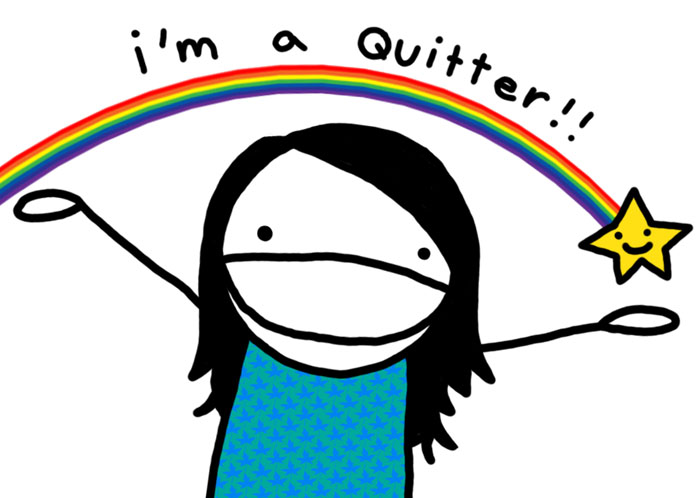
I'm a quitter! And I'm totally fine with it.